


In an interview for Bloomberg’s Wall Street Week, with former Canadian Finance Minister Chrystia Freeland asking the questions, former U.S. Treasury Secretary Janet Yellen declared U.S. trade policy “appalling” and said, “it’s important for Canada and other countries not to accept this lying down and to retaliate.”
That’s a remarkable statement for at least a couple of reasons. One problem, of course, is that Yellen appears more concerned with the well-being of other countries and their citizens, and with the long-deceased abstraction of the rules-based international economy, than with America’s own interests.
The other, not unrelated problem is that she has her story backward. What “other countries” is she thinking of? Everyone else was able to reach agreement with the United States. Canada’s insistence on having the option to build closer trade ties with China prompted it to walk away from negotiations, sparking the current trade conflict. So is Yellen saying other countries should not have reached agreements with her country? That Canada is right to insist on getting closer to China?
Or is the real audience for all this in Davos? In her last year as Treasury Secretary, Yellen testified before Congress that, “we gain and China gains from trade and investment that is as open as possible.” She traveled to China and delivered a speech in Guangzhou, which she celebrated as “the top destination for foreign investment in China” and called “a fitting place for me to emphasize the strong economic ties between the United States and China, and the benefits these ties can bring for both the U.S. and Chinese economies.” Fine sentiments for Carneyland, but not the modern USA.
WORTH YOUR ATTENTION THIS WEEKEND
Secretary of State Marco Rubio gave a phenomenal speech in Athens on the Western intellectual and political tradition, which you should read in full. And somebody deserves a raise… A++ work from the advance team on this staging:

Meanwhile, back in Washington, Vice President JD Vance and Secretary of Labor Keith Sonderling were lowering the boom on H-1B abuse by Indian outsourcing firms and, more notably, Microsoft and Adobe. “The Department of Labor is taking historic action by shutting down the pipeline of systemic fraud, the fraud that has flooded our country with foreign labor at the expense of American workers,” said Sonderling.
Bonus link: Commonplace was all over this a week ago, with an in-depth look at the case against the first DOL target, Cognizant.
How Everything Became Gambling (New York Times). “We are living through a kind of postpandemic gamified speculative-trading apocalypse of which traditional gambling is only one horseman. There’s also crypto, now an enormous industry still searching for a nonspeculative use; stock trading apps like Robinhood, which popularized high-risk, leveraged options trading among retail investors; and, most recently, prediction markets, which saw $60 billion in trading volume last year. Soon, it won’t make much sense to distinguish among these categories, as the apps converge on a multi-offering model featuring some combination of sportsbook, prediction market, options trading and crypto, if not all of the above.”
Bonus contrast: San Antonio Spurs star Victor Wembanyama says of becoming a spokesman for gambling and prediction markets, “I will never do that. Honestly, I think it’s very sad to see some players promote it.” Meanwhile, LeBron James, who has earned more than $500 million playing basketball, just signed an endorsement deal with Polymarket for about four times what he’ll earn on the court this year.
Trump Accounts’ Extraordinary Expansion Puts Individual Stocks Into Kids’ Holdings (Wall Street Journal). A recurring theme here, addressed most recently in Thanks, Sam, But We Already Have a Stake in OpenAI, is that distributing capital to labor is a poor substitute for ensuring a fair distribution of income between capital and labor. When the “ownership society” is a pretext for focusing everyone’s attention on the stock market, while their fate remains tied to their paycheck, it ceases to advance the ordinary citizen’s interests.
WORTH A CHUCKLE
This week’s award for worst effort by a Wall Street Journal columnist goes to Allysia Finley for
Hurray for Higher Mortgage Rates. Finley offers two arguments for high interest rates benefiting homebuyers. First:
The silver lining for home buyers is that higher mortgage rates suppress demand, especially by investors. Higher interest rates combined with elevated home prices, plus slow growth in rents, make housing a less attractive investment.
In other words, high interest rates make buying a home so unattractive that investors will stop trying, at which point home prices will fall and you can get one cheap! But don’t I face the same price as the investors and likewise find a purchase unattractive? And if prices start falling, won’t investors notice at the same time I do? Shhh, too many questions. Second:
The Trump team deserves credit, however, for curbing government mortgage-relief programs that repeatedly waived payments for delinquent borrowers. Foreclosures rose as a result, by 47% over the past year for mortgages backed by the Federal Housing Administration. This isn’t a cause for panic. Foreclosures, suppressed by the Biden team, have merely returned to pre-pandemic levels. This has freed up more homes for buyers and returned demand and supply to a healthier equilibrium. “The ample supply of homes for sale on the market is giving homebuyers better opportunities to negotiate,” the NAR reports.
It’s hard to even know what this argument is. On one hand, did the rise in foreclosures have anything to do with interest rates? If not, hard to say it’s a benefit from higher interest rates. On the other hand, if the argument is that higher interest rates did make adjustable-rate mortgages much more expensive and drive foreclosure rates much higher, that’s… not good. “Higher rates are pricing people out of their homes, giving you the opportunity to buy them” might not quite fly as an affordability message.
BUT PROGRESS ON FINANCIALIZATION IS HAPPENING
This week, the U.S. Treasury Department issued the first penalty for violation of restrictions on outbound investment to China. Also this week, Trump Throws His Weight Behind Credit-Card Legislation Most Feared by Banks (Wall Street Journal). Careful readers will recall last week’s headline item in this newsletter, Treasury (Man) Bites Hedge Fund (Dog), on aggressive action by the administration against tax-avoidance shenanigans at hedge funds. And then there’s the bipartisan housing bill’s inclusion at President Trump’s insistence of a prohibition on institutional-investor-owned housing atop an executive order on the same issue, and another executive order restricting stock buybacks by defense contractors.
The war on financialization is still at its early stages. But the theory of the case, that financial profits unmoored from productive purpose are not a good thing, is at this point well accepted and the real wins against powerful interests are starting to pile up.
COMPULSORY ARTIFICIAL INTELLIGENCE SEGMENT
This was a lovely essay from Walter Isaacson, framing the debate over AI’s likely effect on labor in especially accessible terms: Ada Lovelace Already Answered the Big Questions About A.I. (New York Times). He writes:
On the other side is the Lovelace camp, which holds that there will always be a role for human creativity, intention, agency and empathy. Human creativity involves values, aesthetic judgments, emotions, personal consciousness and a moral sense. … The greatest gains, according to this camp, will not come from machines working alone, but from a symbiosis that tightly connects machine processing power with human creativity in a mutually beneficial way.
BACK IN THE WORLD OF DOLLARS AND CENTS, Spending on AI Is Becoming Almost Impossible for Businesses to Budget (Wall Street Journal). The economics of the technology, and the business models of the labs, remain something of a mystery. Perhaps the next $200 billion of capex will begin to clarify matters.
THE UBI DUMPSTERFIRE CONTINUES TO BURN. Jacob Coxon, the former Anthropic employee who helped trigger the current wave of AI fear with his viral announcement that he was quitting, went on The Daily Show with Jon Stewart to discuss the technology. It did not go well. “I heard you talking about jobs and I think there will be no jobs. There won’t be jobs in this world. This is the world that’s being envisioned by the people building the technology.”
Stewart pushes him on whether a world without jobs would really be such a good thing, and the interview goes quickly off the rails. People best at programming, we are reminded again, tend not to be best at grasping and reasoning about the human condition. As Coxon acknowledged afterward, “I’m far less able to opine on this than the short-term dangers of superintelligence.” An evergreen caveat for efforts from the AI labs to discuss things other than AI models.
Bonus link: Chris Griswold wrote for Commonplace yesterday on the consistent polling result that people do not like proposals to just give everyone money. That applies to UBI, and it applies to the president’s latest campaign gambits.
GIVING PEOPLE MONEY TO REINDUSTRIALIZE, THOUGH…
Lots of good investment news to report:
TSMC Mulls Multibillion-Dollar Texas Campus for More AI Chips (Bloomberg). The tax credit for new fabs “was a cornerstone of former president Joe Biden’s 2022 Chips Act, and it was increased to 35% last year. While an extension has yet to find a viable path to passage this year, Senator Mike Crapo, an Idaho Republican, and Senator Ron Wyden, an Oregon Democrat, have said they are committed to it.”
Anduril Plans a $3.7 Billion Baltimore Shipyard for Virginia-Class Submarines (The Washington Sun). Note the timeline: “Anduril expects the shipyard, dubbed Arsenal-2, to begin hiring in 2029 and launch operations in 2030.” Two to three years from investment commitment to job creation, another year to output. Keep that in mind when assessing, oh, say, the success of tariffs imposed 18 months ago.
Speaking of tariffs imposed 18 months ago, the high reading for the August trade deficit had the usual suspects gleefully declaring tariffs a failure. But something looked odd in the data; the rate of increase was hard to square with actual economic trends and reporting. Unless, that is, you consider the AI buildout. As everyone now knows, AI requires a lot of data centers, and data centers require a lot of chips, computers, and telecom equipment. Those industries are ones that the U.S. offshored entirely, and that take a long time to bring back even as we try to do so quickly (see, e.g., CHIPS Act item above).
So the AI buildout represents an exogenous shock to the trade deficit, unrelated to the effect tariffs might be having. How does the picture look if we separate out the imports and exports of those particular AI hardware categories? I made just such a picture:
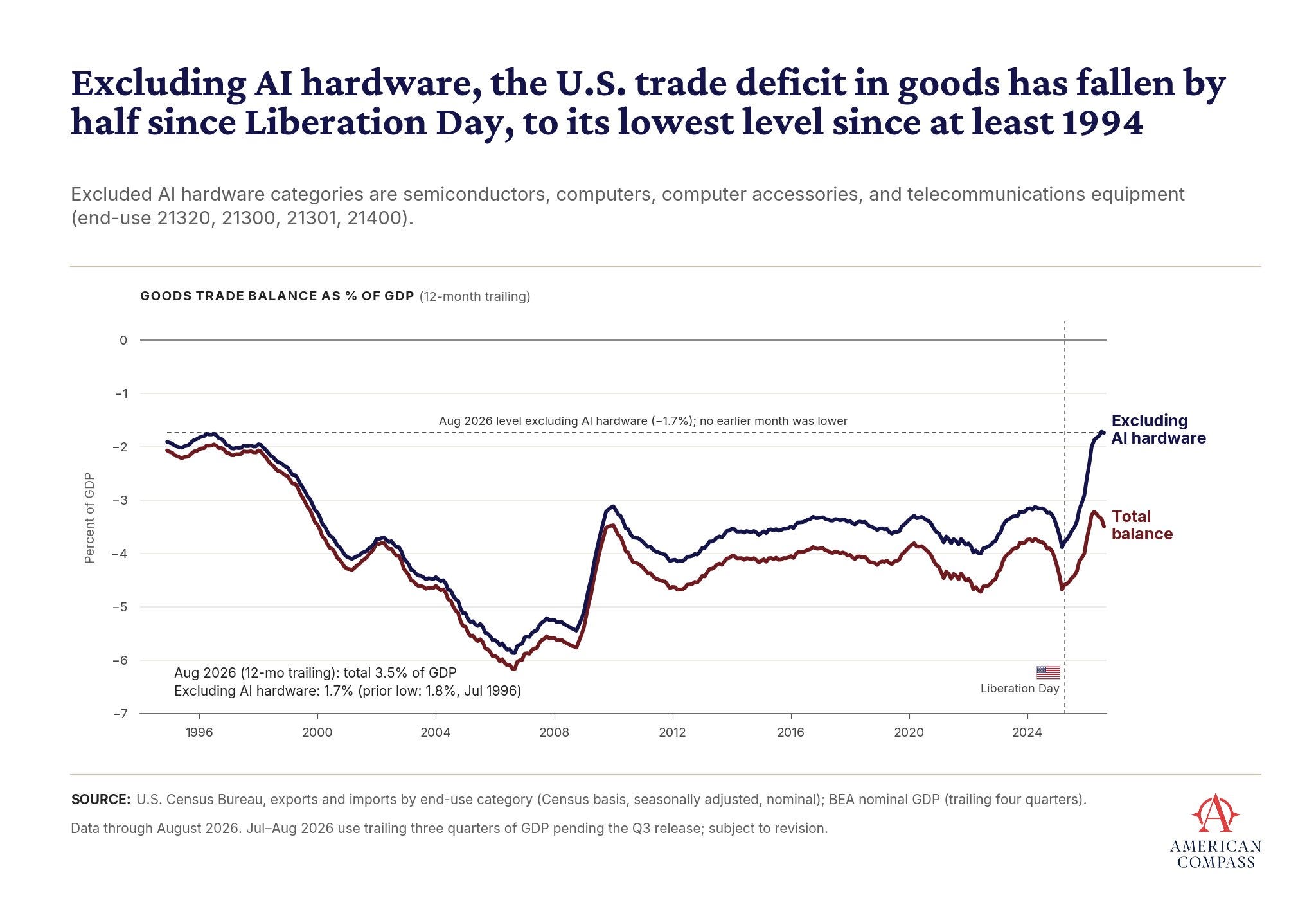
The result is pretty stunning. Even with the AI hardware (the red line), the trade deficit has closed in recent months to a 12-month average as low as any time since the year 2000. But look at the blue line, which excludes AI hardware. The deficit in trade across all other categories of goods has fallen continuously since Liberation Day, by half overall, to its lowest level on record (going back to 1994). That’s kind of incredible.
To be clear, the point is not to suggest that AI hardware somehow “doesn’t count.” For purposes of in fact closing the trade deficit, we need to deal with AI hardware too, and this data underscores just how costly it has been to abandon technological leadership in these areas. But if we want to know whether tariffs are working, a sudden explosion in demand for goods that can only be imported while we race to rebuild our own production capacity only obscures the answer. Focusing on those areas that were not so disrupted gives us a better picture of what policy is doing, and that picture is an encouraging one.
Back to the encouraging specifics, like Bayer to invest $2.2B in Ohio pharmaceutical facility (Manufacturing Dive). And the Office of Strategic Capital, whose announcements are coming fast and furious:
Will Cooper: “Today, the @DeptofWar’s Office of Strategic Capital announced a $1.5 billion conditional loan commitment to Wolfspeed to help strengthen the U.S. supply chain for silicon carbide (SiC), gallium nitride (GaN), and other wide bandgap semiconductor materials.”
Will Cooper: “The @DeptofWar’s Office of Strategic Capital (OSC) announced today a $150 million conditional loan commitment to @PsiQuantum to enhance the company’s advanced manufacturing and prototyping capabilities in the United States.”
Syringes provide a good case study. MedTech Dive reports that BD strikes supply chain pact with Trump administration. This will be a good test of the administration’s approach to encourage reshoring of medical supply chains, which establishes a stiff Section 232 tariff but offers short-term relief to firms that can demonstrate they are actively working to reshore production. From the report: “BD said Tuesday it has struck a partnership with the Trump administration to expand domestic manufacturing and strengthen the supply chain for medical consumables. BD, a maker of syringes, needles, infusion pumps and other medical products, said it will invest a total of $19 billion in the U.S. over several years. The pact includes investments in U.S. manufacturing, innovation and end-to-end production capabilities, the company said. The agreement provides relief from any future tariffs on BD products under Section 232, subject to BD achieving undisclosed milestones.”
This reminds me of HBS professor Willy Shih’s analysis in the Financial Times of exactly the same product from exactly the same supplier. He concludes:
But, for a matter of just pennies per syringe, the US seems to be going down a path towards losing its last large-scale domestic syringe manufacturing capacity. I recently received my Covid booster and flu shots, and I would have happily paid a nickel or a dime more for domestically produced syringes to make sure I could get them in the next pandemic.
But Professor Shih’s willingness to pay a nickel will accomplish nothing. Secretary Yellen’s efforts to ask the Chinese nicely will accomplish nothing. Tariffs accomplish a lot.
WHAT ELSE IS HAPPENING WITH CHINA?
Former CEA chair Jason Furman highlights a chart showing: “China goods imports as a share of total U.S. imports. Note the share is now below what it was prior to PNTR.” Another remarkable data point. People often note that a significant share of those imports from China are still coming from China but pass through some other country en route to the U.S., affecting the data. But Furman considers that too, and concludes that, “a bit more than half of the decline since 2016 appears to be genuine.”
Chip-making equipment remains an issue. Nicholas Brown has the definitive paper on the way China is continuing to access and make use of advanced chip-making equipment, which threatens to erode one of the few U.S. advantages in manufacturing.
The FCC strikes again, this time blocking the use of Chinese test labs to certify electronics for sale in the United States. Chris McGuire has the definitive chart, showing that the U.S. held a market-leading 30% share of testing 20 years ago while China had less than 10%. Today, China stands at 82% and the U.S. below 4%. Raise your hand if you think this is because China has a comparative advantage in testing electronics. Anyone? No? Well, good news. Thanks to the FCC, that share will fall toward zero in the next couple of years as testing must be done elsewhere for products that enter the U.S. market.
And sorry again, Secretary Yellen: Thailand at ‘last paragraph’ of US trade agreement, PM says (Reuters). “The United States is Thailand’s largest export market, accounting for 24% of the southeast Asian country’s total exports so far this year.” Look at where Thailand is on a map, and then consider that it sells more to the U.S. than to China. Maybe we’re not such a bad trading partner after all!
YOUR BAD TWEET OF THE WEEK IS THIS POORLY TIMED SHOT…

CHASER!

The chasing continues, with Brad Setser: “We will see if it works, but kudos to Europe (and especially France and Germany) for trying to learn from the US example in 2025.” And Peter Harrell: “...would mark the most significant change to EU-China policy in decades.” And Nick: “Our global tariffs prevented Europe from offloading the pressure from diverted Chinese exports by simply increasing exports to the US. Without global tariffs, we remain consumer of last resort and balance Europe’s imbalance.”
It seems like maybe the Liberation Day regime has in fact been supremely successful in turning the tide against Chinese overcapacity. No, the problem is not yet solved, but the trajectory seems about as promising as one could hope. Will Canada be able to absorb the entire Chinese surplus itself? Time will tell…
Even the UK has gone this week from How Britain Learned to Love Chinese Cars—Especially a Look-Alike Range Rover: The Jaecoo 7, made by China’s Chery, was the U.K.’s bestselling vehicle in September (Wall Street Journal) to Britain set to levy tariffs on Chinese electric cars (Reuters).
In fairness to Secretary Yellen, she too spoke about this issue, on her visit to Guangzhou:
I’m especially concerned about overcapacity, which members of the Chamber identified as a concern in the Chamber’s recent survey as well. Overcapacity isn’t a new problem, but it has intensified, and we’re seeing emerging risks in new sectors. Specifically, direct and indirect government support is currently leading to production capacity that significantly exceeds China’s domestic demand, as well as what the global market can bear.
And she too had a plan: “This will be a key topic in discussions with counterparts in the coming days.” Did those discussions work as well as the tariffs she wants countries to retaliate against? That hardly seems the point, I suppose, when there are norms to uphold and views to exchange.
AND YOUR CANADA GOOSE OF THE WEEK IS…
Julie Dabrusin, Minister of the Environment, Climate Change and Nature, who filmed a video of herself in China, where she went “to deepen our cooperation to lower global emissions.”

Good luck to you, Ms. Dabrusin.
And to everyone else, enjoy the weekend!
The same economists who spent decades lecturing us that any US response to China's obvious unfair trade practices would only hurt American citizens... are now declaring that other countries must respond to US tariffs to protect thier citizens.
Maybe they weren't free traders after all. Maybe they were just un-American.
Janet Yellen? omg part of the banker's cartel. Davos neo con globalist who has never had a real job. Academic and government only.