


I am sorry to disappoint you, but this week’s newsletter will not be a long and detailed examination of what role tariffs may or may not have played in Tuesday’s midterm drubbing.
Did voters suddenly turn against Trump for implementing the one policy that he has most consistently campaigned on and pursued while in office? Did tariff policies that had their most disruptive effects in 2025 lead suddenly to the collapse in his approval rating and his party’s electoral prospects in 2026? Was their very small effect on the price level, as inflation slowed toward 2%, the source of affordability concerns as inflation spiked for unrelated reasons a year later? Who’s to say.
It would be nice if the national exit polls had asked these questions, but it turns out the tariff theory was sufficiently outlandish that they didn’t even test it. What? I hear you say. But everybody is tweeting exit polls showing that tariffs are to blame. No, actually, they’re not.
The national exit poll tested five issues, asking how important each was to the person’s vote for Congress: cost of living, war in Iran, artificial intelligence and data centers, immigration enforcement, and government corruption. Not tariffs. The poll did ask whether tariff policies had helped or hurt the economy. Among Republicans, only 28% said tariffs hurt. Among Democrats, 96% said tariffs hurt. Of course, they were looking at the same economy. It’s a purely partisan result. So congratulations everyone, you figured it out, Democrats have a really low opinion of Trump’s trade policy.
Anyway, if you want to find the extremely motivated free traders using extremely motivated reading to insist that suddenly, after a decade, the president’s consistent commitment to a policy they dislike has led the nation to turn against Republicans in unprecedented numbers in deep red states, well, enjoy. If you want to read actual analysts applying actual thought to the situation and reaching the obvious conclusion, you can find those too.
I’m more interested in talking about something voters did seem to have on their mind: corruption. Voters identified corruption as their top issue heading into the election and the exit poll then shows it was number one, even ahead of cost of living. What, in this context, does “corruption” mean? The standard assumption seems to be that the American people were rejecting corruption in the White House. To be sure, that very much requires rejection.
But the pollsters also asked, “regardless of who you support, which party would you say is better able to handle government corruption?” And here, 37% chose the Democratic Party, 30% chose the Republican Party, and 32% chose “neither.” That’s not the split of a country just fed up with the president’s corruption. That’s the split of a country fed up with its elite.
It also suggests that other intersecting factors must be playing a role. After all, the country has been fed up with its elite for a while. Perhaps the president’s conduct was the straw that broke the camel’s back. Perhaps, at a time when cost of living is the other top issue, the juxtaposition of ordinary people struggling to make ends meet on one hand, and the people at the top using their power for personal gain on the other, is too much. I recall a focus group we once conducted in which we asked people who they saw as more of a problem, corporate leaders or political leaders, and they outright rejected the choice. They saw no difference between the two groups, indeed refused to consider them two different groups at all. They used other words, but their perception was of an oligarchy that existed only to serve itself.
From this perspective, the Iran war is more than just a disastrous choice by President Trump. It may fit under a corruption heading as well. How is it that, after nearly two decades of failure in the Middle East, a president comes into office promising “America First” and then, sure enough, goes and starts another war in the Middle East? One might reasonably conclude that other, unaccountable centers of power get more influence over American foreign policy than the American people, and that the president set policy with little regard for what ordinary Americans want or what would best serve their interests. Corruption does not require a bribe; it is enough that people with the obligation to act on behalf of the American people choose to act on behalf of themselves and their friends instead.
People undoubtedly are frustrated with the Iran war because of the rise in gas prices. But we do them a great disservice when we treat that as the entire problem, or even the main problem. Americans have no problem accepting costs that come with a cause they support in pursuit of an objective that will better their lives. Conversely, unwise entanglement in wars that lack popular support or clear objectives will invariably produce outrage, regardless of their effect at the pump. No one should expect to succeed in representing the citizens of a republic by treating them as subjects of an empire.
And so we get another resounding vote of no confidence and another changing of the guard. The magnitude of this particular rebuke underscores the magnitude of President Trump’s failures and the mistrust in his style of governance. But his election two years ago was a fairly stark rebuke to the Democrats, who have shown themselves more than capable of earning another two years hence. This is all we will get until leaders emerge who are prepared to take seriously their obligations to the people they serve. Reclaiming American Citizenship, the statement published by American Compass in June, aims at precisely this problem and articulates the approach and message that the nation needs, now more than ever.
GOOD READS FOR YOUR WEEKEND
I’ll keep the rest of the newsletter short this week, but a few things that caught my eye:
The Decline and Fall of Rigor in Advanced Placement (EducationNext). This is a devastating dive into the slow-motion collapse of academic rigor; not compelled by a nefarious agenda, just the slow slide toward mediocrity. I worry about this especially with the way AI is degrading studying and preparation for high school and college students. Do schools have the stomach to maintain standards and use failing grades as a consequence for failing to learn the material, or will expectations collapse as quickly as performance? Take a look at the article, the concrete examples really drive this home. Out with the King Lear question, in with the People magazine question about “embracing the present moment.”
The Secret Code of Pickup Basketball (The Atlantic). This is a couple of years old, but I just came across it, and this is my newsletter, so I can do what I want.
Jimerson has a poetic and plainspoken definition of sociology: He calls it “the science of people doing things together.” He took on pickup basketball as a research subject because it’s a very difficult thing that groups of people do together—even when they are very different from one another. If good feelings pass frequently among them, that helps. Rogers was interested in how players generate this atmosphere of fellow feeling. He had read Jimerson’s work; he was a prepared observer. He noticed that teammates maintained a strong norm of mutual encouragement, even—or especially—when one of them wasn’t very good. “Someone would miss a shot, and instead of their teammates saying, ‘Don’t shoot anymore, loser,’ they would say, ‘Keep shooting, shooter,’” Rogers told me.
Hedge Fund Elliott Warns of FOGO: Fear of Getting Obliterated in the Market (Wall Street Journal). Seems like the bigger problem is that Elliott is getting obliterated by the market, delivering a return of 2% this year. I’m easily outpacing that with my savvy strategy of buying a short-term Treasury Bond and, when it matures, buying another.
REINDUSTRIALIZATION PROCEEDS APACE
Have we reached the breaking point at which honest economists begin to acknowledge that reindustrialization just might be underway?
On Friday, the Association for Advancing Automation reported that industrial robots purchased in North America in the third quarter were “up 26.1% from the same period a year ago, data show. Manufacturers across industries, including semiconductor, biopharmaceutical and metals, had ‘substantial increases’ in orders as capital poured into the U.S. market for facility automation and expansion” (Manufacturing Dive).
On Sunday, ISM released its October PMI report, up a point to 55.5, with “New Orders Growing, Production Growing, Employment Growing.” S&P released its report as well, at a similar 54.9, noting “US factories continued to report strong expansion in October, sustaining the sector’s best growth spell since early 2022. The upturn is also generating jobs at a pace not seen for five-and-a-half years, during the surge in demand seen during the pandemic.”
On Tuesday, we got the monthly report on job openings, with those in manufacturing logging a third straight month at (non-COVID ) record highs.
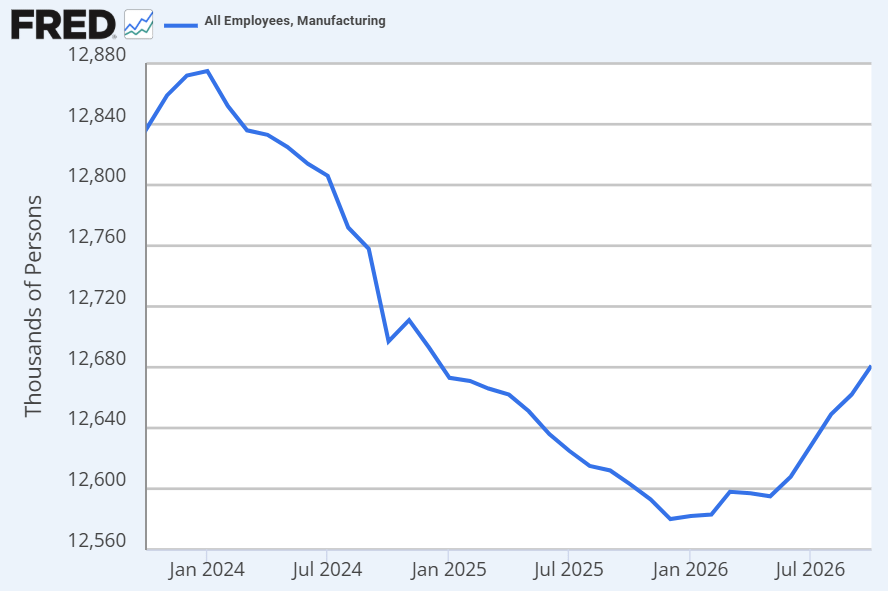
And today was the monthly jobs report, which announced another 19,000 new manufacturing jobs, pushing total employment in the sector to its highest since the end of 2024. I guess one could look at this chart and say “no effect here!” (AEI’s Michael Strain does), but sophisticated data analysis is unnecessary to believe one’s own lyin’ eyes.
I was also delighted to see that Jason Furman (who has created a terrific new EconVitals dashboard) adopted a methodology similar to mine for separating the trade deficit into imports and exports of “Data-Center Goods” versus “Everything Else” and finds, as I reported to you last month, that while imports of computer equipment for data centers have surged, the trade deficit across all the rest of the economy has plummeted by more than half since Liberation Day.
Enjoy the weekend!
Good point about tariffs. I am unconvinced about the war. Foreign policy seldom moves the needle. While I disapprove of the war, it had zero impact on my vote. I disapprove of our involvement in Ukraine too and Democrats and Neocons cheerlead for that. While we have no disclosed fatalities in Ukraine, the number in Iran is 12 last I saw. Hardly an Iraq or Afghanistan level much less Vietnam. Gas prices do move the needle. I am angry about $5 but that doesn't make me support the party that wants $10. Perhaps the connection is the constant happy patter coming from the White House about both wars with no movement. I am old enough to remember the "credibility gap" that ruined LBJ. There is much less trust today than then so this is likely to have an outsized effect. Early indications are that Republican turnout collapsed. Is this anger or the natural effect of increasing Republican dependency on less engaged voters.
Across all voters, 66% said tariffs hurt the national economy vs. 21% who said it helped. It was 64% vs. 14% for the local economy. If we restrict to men, where the D/R party split is almost exactly 50/50, it's 61% hurt, 25% helped for the national economy and 59% to 18% for the local economy.
This is a "purely partisan result" to you ?!?