



The goal of a political campaign is to generate as much enthusiasm as possible among as many voters as possible for casting a ballot for your candidate. In recent years, we have seen a sharp increase in a peculiar strategy for accomplishing this: Politicians tell their voters that an election is rigged and that, regardless of who gets the most votes, the opposing party is going to try to steal it.
Republicans relitigate the 2020 Election and condition confidence in November’s results solely on passing the SAVE America Act’s proof-of-citizenship and voter-ID requirements. Democrats warn their side that the other will “cheat,” “rig the rules,” and “steal the election.” The bet seems to be that outraged partisans will surge to the polls with a righteous fury, but that bet is a bad one. If anything, the tactic not only corrodes the public’s faith in the institution that gives elected officials their power, but also discourages turnout by telling voters that their votes don’t matter.
We both help Republicans win elections for a living. Over and over again, we see that talking to people about their priorities and taking their concerns seriously works. Telling them the game is rigged makes them feel powerless, so they tune out and find something better to do with their time.
Nobody builds a business they expect to fail. Nobody gives money to a candidate they know will lose. People do give money when they believe their contribution could be decisive. The same logic applies to the ballot box. The rigged-election message gives people a reason to stay home that feels righteous rather than lazy.
The voters Republicans most need this fall are the ones for whom “it’s rigged” is not a call to arms but permission to stay home. In a September national survey conducted by Cygnal for RightCount, which tracks election confidence nationally and in several states, about a third of Republicans (34%) say they would be more likely to vote for a candidate who says 2020 was stolen. But that group was never in play. But 99% of them also say they would vote for any generic Republican for Congress. These aren’t wobbly voters waiting to be won over, or looking for a push to get out to the polls. They’re very conservative (62%), highly engaged, and were always going to turn out.
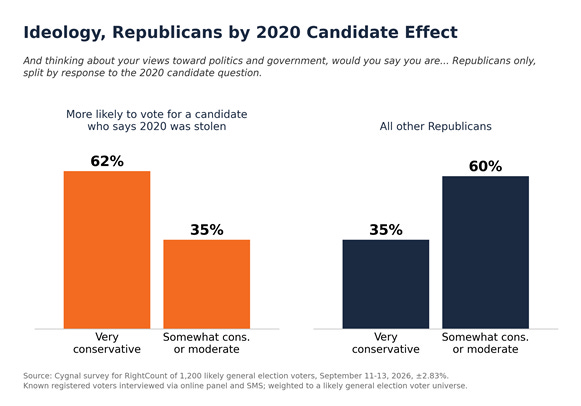
The other two-thirds of Republicans aren’t interested in candidates who talk about stolen elections, and 88% will vote for the Republican candidate for Congress. Sixty percent are somewhat conservative or moderate; only 35% are very conservative. This is who Republicans are slipping with. It reflects a real split in the party showing up in other surveys.
In Cygnal’s October National Voter Trends (NVT) survey, 56% of Republicans now call themselves Traditional Conservative Republicans, whereas just 42% described themselves as Trump Republicans. We found a similar pattern. Among the most pro-Trump Republicans, 99% are voting for the Republican for Congress in November. Among Softer Republicans just 88% will do so, and 15% of those aren’t very motivated to vote.
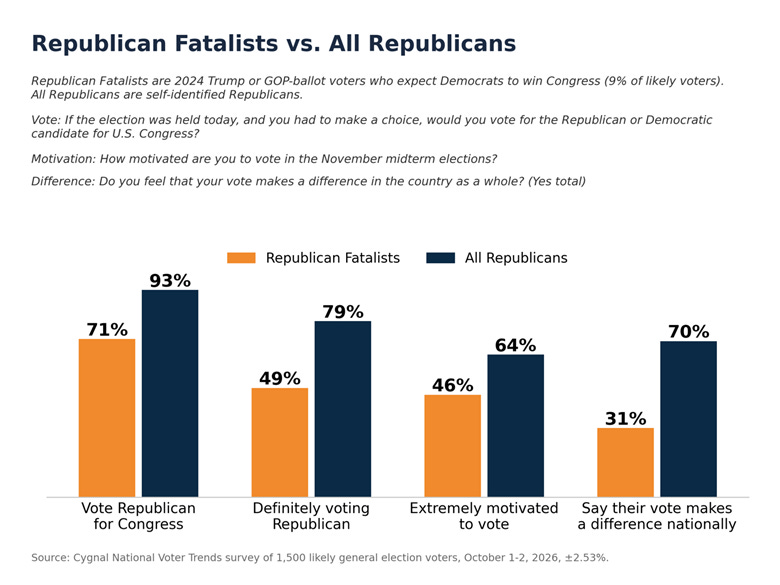
In that same October survey, 9% of the overall electorate fit a profile we call Republican Fatalists, voters who pulled the lever for Trump or the GOP in 2024 but now expect Democrats to win Congress. They represent roughly one in five voters on the Republican side. Only 71% intend to vote for a Republican candidate for Congress, and only 49% say they are definitely voting Republican. Only 31% say their vote makes a difference nationally. These are recent Republican voters who have looked at the political environment and concluded that they got nothing for their vote last time they showed up and the effort may not be worth it. The Republican pitch to bring them back has to make them feel like a trip to the polls might help lead to change. The rigged-election message does the opposite.
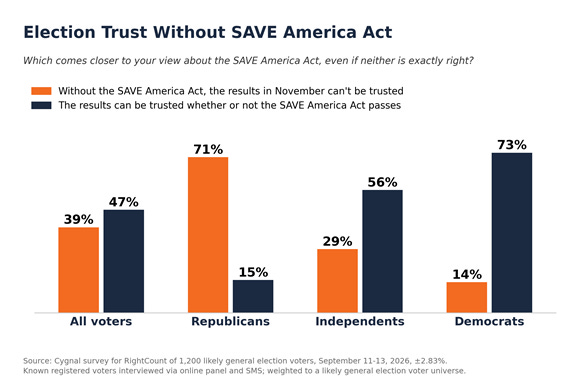
Conditioning confidence in elections on passage of the SAVE America Act sends the same message. Nearly three-quarters (71%) of Republicans say that, without the SAVE Act, the election results can’t be trusted. The bill won’t pass before November, so the 2026 midterms will be run under substantially the same rules as 2024. Perhaps because of the outcome that year, only 15% of Republicans believe fraud changed it. But in rallying support for the bill, Republican leaders have asked people to vote while telling them not to trust the result.
Georgia’s Senate runoffs in January 2021 showed what this rhetoric produces better than any survey can. At the end of his first term, Trump spent weeks telling supporters that mail voting could not be trusted and the system was rigged. Senator David Perdue received about 250,000 fewer votes in the runoff than he had in November. (Kelly Loeffler gained votes, but only because her November race was a 20-candidate jungle primary. The Republicans in that race combined still lost about 230,000 votes.) Both Republicans lost and the Senate flipped. The evidence that rigged-election messaging increases turnout among persuadable voters does not exist. The evidence that it depresses turnout is accumulating.
Voters tell us what would move them. In September, 26% of likely voters named inflation and cost of living as their top priority. That figure climbed to 32% in October. In RightCount’s national poll, only 8% chose election integrity and voting reform. That 8% skews very conservative, over 65, and already voting. Talking to them about 2020 is not an act of persuasion, it’s an indulgence: entertainment for people watching cable news. Every minute a candidate spends talking about voter rolls is a minute not spent on grocery prices. Voters are practically screaming that they want their government to focus on lowering prices.
A party that fails to meet voters where they are shows it is out of touch. Candidates can still talk about election integrity, because voters do support election reform. Voter ID draws 70% support. Proof of citizenship to register draws 73%, including majorities of Independents and a meaningful share of Democrats. State-run elections beat federal control 59–32.
Statewide surveys Cygnal conducted for RightCount Action in Iowa and Texas make the distinction concrete. Thirty-nine percent of Iowans and 42% of Texans believe fraud changed the 2020 national results. Ask about their own state’s 2020 election and those numbers fall to 7% in Iowa and 17% in Texas. People trust what they know. Both states already require voter ID. Both already check their rolls for noncitizens.
The candidate who tells voters what their state already does right and frames federal legislation as extending what works is running on election reform. That argument assumes the system can work, because most voters in most states believe their own system does.
The candidate who calls the whole thing rigged is making a different argument. He is presenting the system as broken beyond the reach of the people he is asking to participate in it. If he is a Republican, he is telling those Republican Fatalists that they are right to stay home on Election Day or “forget” to mail in an early ballot.
Leaders on both sides are doing exactly what they accuse the other of doing and profiting from the clicks, likes, and fundraising dollars the outrage generates. This rhetoric has had an effect. In September, 35% of voters, including 40% of Republicans and 32% of Democrats and Independents, expected there to be widespread fraud and process errors that impact election results in the midterms.
American political institutions survived the stress tests of the last decade. The courts ruled. Congress certified. The transfers of power happened. The guardrails held. Most voters still believe that elections are legitimate and the final word on who governs. But a large and growing minority in each party no longer does. Political culture has proven far more fragile than institutions. Voting depends on that culture more than any other institution, because it isn’t compulsory. People have to believe that showing up makes a difference.
Our political culture must recover the shared belief that voting is the necessary, impartial mechanism through which citizens exercise political power. Politicians who undermine that belief are making a strategic mistake and destroying the only source of legitimacy they have.


The cake is baked for lack of confidence not only in elections but all institutions. Your yesterday's column about reconciliation (in an accounting sense) is what is needed to start to restore confidence. Even so, it is a long process.
The quote often attributed to Stalin about the vote counters are what matters was actually from Boss Tweed and is as American as apple pie. There are real concerns about the integrity of the process. The French used to do vote by mail but abolished it as prone to fraud.
How low T of the authors. At least have the guts to say “his” name. He’s obviously the leading vector of misinformation regarding election integrity. He’s that guy who has convinced 70% of my former party that his loony conspiracy theories are true in spite of his repeated losses in court for lack of evidence. Same guy who fomented an insurrection leading to the first non-peaceful transfer of power in our nation’s history. The guy who summoned MAGA-hatted thugs to beat cops with Confederate flagpoles. It seems like he might merit a mention in a serious piece on election integrity?
DC operatives like these two gents, R elected officials, party drones, think tank hangers on, they’re all too timid to even utter Don’s name. It’s like he’s Voldemort, he who shall not be named. If I don’t actually say his name, maybe I can stay on the team, get more contracts, and still get invited to the cool kid parties. It tells you all you need to know about their seriousness, and their willingness to tell the truth. As does the false equivalency when the operatives in turn “call out” D’s for telling the truth. Of course D’s would warn about Don “cheating” and “stealing the election”, he’s already done it once. We watched it on TV, and we listened to R’s from throughout the country testify to his actions. At least a few souls in my former party still think character counts.
One day, we’ll all have to explain to our grandchildren which side we were on when this aging, corrupt, incoherent, narcissistic, imbecile rode through town. If only we could be a fly on all the walls to hear today’s apologists explain how hard they worked to oppose him:)
Good luck America.