


We’ve been busy, to say the least, at American Compass this week so I wanted to be sure you saw a couple of key publications:
Our new collection on integrating AI into a good society and good lives: What Compute Can’t Buy.
A comprehensive assessment of progress toward reindustrialization and the issues that drove midterm voters, with detailed economic data and public opinion research: The Post-Midterm Post-Mortem.
In promoting that analysis on reindustrialization, I tweeted a series of charts showing the manufacturing boom underway, to which Harvard economist Jason Furman had a peculiar response:
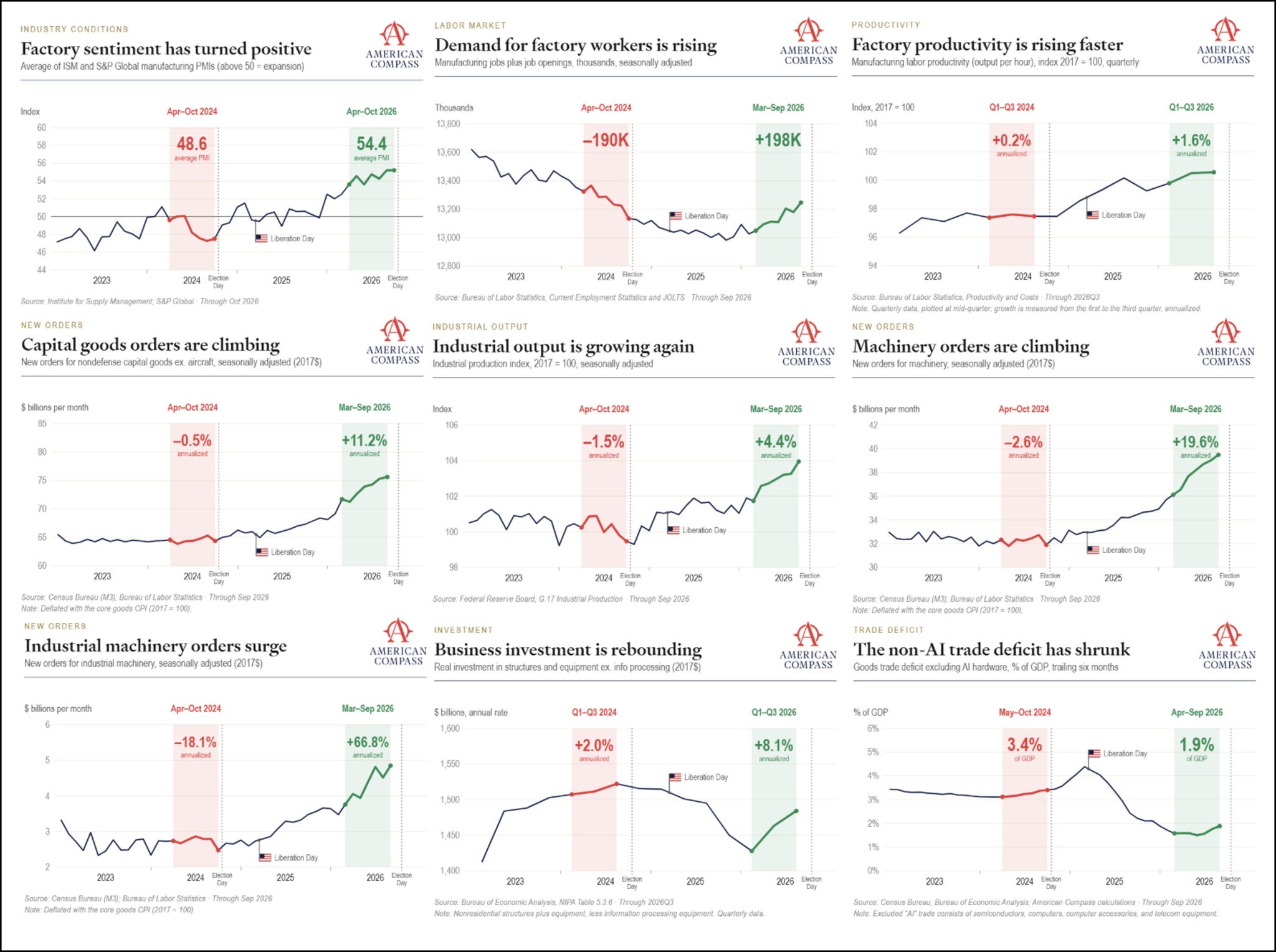
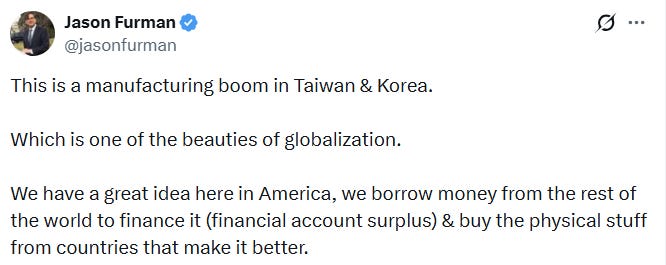
First, there may well be a manufacturing boom in Taiwan and Korea. And maybe that boom is boosting demand for U.S. manufactured goods (seems unlikely, but OK). Great. Or whatever. Doesn’t matter. The point is that the American industrial sector is experiencing rising sentiment, employment, orders, output, and investment. Just a strange non sequitur that would seem to serve little purpose except to talk down U.S. economic progress.
But what follows is even stranger. Furman’s account of what’s happening is that we have the idea, we borrow money to finance it, and then we buy the physical stuff from elsewhere. Is that really the “beauty” of globalization?
This is a very nice illustration of how the financial account surplus and current account deficit are two sides of the same coin. The “finance it” is the “buy it.” The world makes the stuff and sends it to us, we send back pieces of paper that say “IOU.” Seems like there might be a few problems here.
For one thing, this seems like a good way to end up deeply in debt (which, not incidentally, we are). Second, this seems like a good way to end up not knowing how to make anything yourself, which is going to make paying off the debt really hard (which, not incidentally, it now is). Third, if we just have the ideas, and someone else makes all the stuff, it seems likely we will end up with a lot of really great jobs for the people who come up with ideas, and not a lot of really great jobs for the people who make stuff (which, not incidentally, is what we have).
Fourth, we might want to know why other countries make the stuff better, especially when the ideas were ours first, and we used to be better at making it. If we imagine another world in which we have a great idea, we can make it here ourselves and so have more good jobs for Americans and get better at making things, wouldn’t that be better? At least we wouldn’t have professors tweeting that the real boom is in Taiwan and Korea.
GOOD READS FOR YOUR WEEKEND, ROBOTICS EDITION
US Companies Turn to Robots to Ease Labour Shortage Crisis (Financial Times)
“American companies are racing to install more industrial robots in factories and warehouses, as rising costs and worsening labour shortages threaten to choke off a nascent US manufacturing boom. North American companies ordered almost 11,000 robots in the third quarter of 2026, up 25 per cent on the same period last year, according to the Association for Advancing Automation (A3). Orders of collaborative robots, or ‘cobots’, rose by 56 per cent. Peggy Johnson, chief executive of Agility, a humanoid robotics company that listed on the Nasdaq this month, said that many manufacturing firms were facing ‘an existential problem with the labour that they can’t get’. ‘There’s an older workforce doing manual, repetitive jobs that is retiring, we have a younger workforce that is not seeking those jobs, and then we have a government that is reshoring and that’s increasing the need for those jobs,’ Johnson told the FT.”
More capital investment in higher productivity to support a nascent manufacturing boom? OK, then!
GM Plans 20% Boost in Robotics as Factory Costs Rise (Reuters)
“General Motors is aiming to increase use of robots and other automation by 20% at its North American factories by 2028, two people familiar with the matter said, as the automaker grapples with higher labor and onshoring costs. The Detroit automaker is developing its own robots and assembling them at its Kokomo, Indiana, plant, the same people and two other people said, and is focused on using autonomous mobile robots to move parts around its plants.”
Developing new automation technology ourselves, rather than relying on imported tools? That sounds pretty good!
How Smart Manufacturing Is Shaping the Automotive Industry (Manufacturing Dive)
“With growing cost, operational and competitive pressures, automakers are starting to expand automation into areas that have historically depended on operator experience and judgment, an analyst said at Rockwell Automation’s industrial automation fair this week. Automation is embedded into the fabric of the automotive industry. Manufacturers already leverage these systems for repeatable, predictive functions such as stamping, body, paint, welding and final assembly. However, automation is becoming an even more important part of the automotive manufacturing process as companies look to drive earnings growth, according to Edgar Faler, the principle mobility analyst and strategy lead at the Center for Automotive Research. ‘Some of that is through the productivity gains that are enabled by automation, by smart manufacturing data, by AI,’ Faler said during a session at Rockwell’s event in Boston on Tuesday.”
Operational and competitive pressures sound useful!
Perhaps most importantly, laser weeding in broccoli.
IN OTHER IMPORTANT POLICY NEWS
The permitting bill advanced through the Senate. Read Greg Ip: This Permitting Overhaul Can’t Come Fast Enough (Wall Street Journal).
The White House is signaling its openness to a fiscal deal with Democrats that would raise new revenue: Bessent opens the door to fiscal deals with Democrats (Politico). “Treasury Secretary Scott Bessent signaled on Thursday that he is open to negotiating fiscal deals with newly empowered Democrats, saying he’d support tax changes that could raise revenue in addition to spending constraints to reduce the deficit.”
And Senator Ron Johnson suggests shutting down Social Security: “At this point, there’s really no way to fix Social Security. It’s a Ponzi scheme. You can’t fix it. You just shut it down and hope that you can recover some of your money.” The Wall Street Journal editorial board applauds. “Ron Johnson Tells the Social Security Truth.”
A CORRECTION AND AN APOLOGY
The Cato Institute’s Scott Lincicome called my attention to an error that I made a couple of months ago, in The Baghdad Bobs of American Industry. There, I had written of free traders who eagerly promoted manufacturing data called PMIs while they reflected poorly on the sector, and then stopped doing so when the data turned positive, “Scott and Noah don’t tweet about PMIs anymore.” But as Scott notes, he had tweeted about a PMI that month, emphasizing that “the Iran war and tariffs threats [sic] continue to be the biggest concern to the manufacturing economy.” In August, he had also tweeted about a PMI for China.
Here is what I should have written:
While Scott spent a year eagerly tweeting topline PMI reports to advance the narrative that tariffs were failing, often with commentary like “oooooooof”, “tariffs are hammering the industry”, “pretty big manufacturing miss”, “brutal”, “pretty brutal ISM survey”, and “☹️”, he decided against doing so when the reports turned unmistakably positive. By this May he was highlighting only the “ISM manufacturing prices sub-index” and then in the summer he just stopped, instead penning a lengthy explanation at Cato about how really you shouldn’t put too much stock in PMIs anyway -- “sentiment isn’t output” and they “can misrepresent what’s happening nationwide and over the long term.”
I regret the error and have updated the piece.
ELSEWHERE IN THE REINDUSTRIALIZATION
The Success of President Trump’s Tariff Policy (Jamieson Greer, Wall Street Journal)
Japan Attempts to Revive an American Industrial Icon (New York Times)
After its fraught takeover of steel maker U.S. Steel, a Japanese manufacturer is attempting to revitalize the American company’s facilities, including its oldest mill outside Pittsburgh.
“For years, the Edgar Thomson steel mill stood on the outskirts of Pittsburgh as a rusting symbol of faded American industrial power. Two years ago, the plant, opened by Andrew Carnegie in 1875, appeared to be on the brink of closure, threatening to take hundreds of jobs with it. Today, however, the mill is being jolted back to life by an unlikely savior. Following a fraught $14.9 billion takeover of U.S. Steel by Japan’s Nippon Steel, a squad of translation app-wielding Japanese engineers has descended on the plant, armed with a multibillion-dollar mandate to drag the aging facility into the 21st century. In the Mon Valley, an industrial region winding along the Monongahela River in southwestern Pennsylvania, land at the Edgar Thomson site is being cleared for a new steel rolling mill the length of five football fields. Inside the existing facilities, equipment is being upgraded, while engineers dispatched by Nippon Steel are introducing new and more efficient Japanese steel-making techniques. In Mon Valley, ‘the excitement level is the highest I’ve seen it here in my 27 years,’ said Ron Ferchak, a director at U.S. Steel’s Mon Valley Works. The hope, he added, is ‘that this will be an operation that will carry on for decades.’”
Hadrian: “Kutztown Foundry, pouring metal in Pennsylvania since 1866, is now Hadrian Factory 6. We are investing $300M to upgrade and expand it, adding the casting capacity America’s naval and munitions supply base needs.” (Cool video, too.)
Honda invests $462M in Alabama plant to boost production (Manufacturing Dive)
“Honda Motor Co. is investing $462 million in its Alabama Auto Plant to boost production of high-demand models and add a line to manufacture a new V-6 engine for hybrid models, the automaker announced in a press release…The investment in Alabama follows a separate $3 billion investment Honda announced on Nov. 10 to build a new factory in Ohio to produce more hybrid vehicles to meet growing demand in North America. That plant is slated to start production in 2029.”
The House China Committee released a thorough report on Chinese trade and industrial policy abuses, with valuable case studies on the biomanufacturing, aerospace, semiconductor, and machine-tool industries, Rigging The Game: How China Undermined Western Manufacturing and Helped Hollow Out American Industry. Key findings:
China has built a state-directed economic system designed to concentrate capital, resources, technology, and global market share in strategically important industries.
China engages in a whole-of-society effort when it seeks to dominate certain important global industries, combining a series of interlocking measures to accelerate the growth of targeted industries.
China seeks to make the world dependent on Chinese manufacturing, while it eliminates its own foreign policy supply chain dependencies.
AND THE NVIDIA CHIP DEBACLE CONTINUES TOO!
During the Alice in Wonderland year of pretending that Nvidia and Jensen Huang were making really thoughtful and serious arguments about how China is “nanoseconds behind” the United States and we should sell them lots of advanced chips, everyone was supposed to nod seriously that this was worth considering. But now, we get Wall Street Journal reporting like: China’s AI Firms Are Addicted to Nvidia Chips. Now They Are Facing Withdrawal:
The move to cut off China from high-end American computing power delivers a heavy blow to Beijing’s AI prospects, particularly in the near term. China matches or beats the U.S. in many of the factors that drive progress in AI, such as engineering talent and access to energy. But it is at least 10 years behind the U.S. in making the best chips.
Despite a push by China’s government to promote the country’s domestic chips, the country’s top AI labs have continued to rely on Nvidia hardware to build their flagship models, especially during intensive early-stage training. U.S. restrictions on exports of Nvidia’s most advanced chips to China led many labs to access them through data centers in places like Malaysia and Indonesia to train their models. That workaround may no longer work.
Especially promising, restricting Chinese remote access to non-Chinese data centers is now on the table too. Lawmakers look to add provisions restricting remote access to chips into defense package (Politico):
There is growing momentum in Congress to fold parts of a fourth bill to restrict China’s access to advanced U.S. chips into a must-pass annual defense package.
According to a Democratic Senate aide and two lobbyists with direct knowledge of the discussions, lawmakers involved in the negotiations on the defense package are considering attaching language from the Remote Access Security Act onto the AI OVERWATCH Act, a sweeping bill that would impose restrictions on foreign sales of advanced chips built by Nvidia and other U.S. companies. The people were granted anonymity to share details of the closed-door negotiations.
This is something I argued for in the Financial Times back in August: Congress should hold Trump’s feet to the fire on chips. “The US urgently needs to broaden its export control regime if it’s serious about winning the AI race.”
But we continue to learn more about just how bad this all was. House Foreign Affairs Committee chairman Brian Mast is releasing details on the licensing that the Commerce Department was doing: “The findings include requested sales of 3.4 million AI chips to China, and the approval of more than 879,000 by BIS-including approvals for AI chip exports to Department of War-designated Chinese Military Companies like Alibaba and Tencent. It also includes requests by NVIDIA to depend on possible chip-smuggling fronts to facilitate their sales of advanced AI chips to Chinese companies. This is the most detailed public disclosure in the history of the Export Control Reform Act.”
From CNN, Blacklisted Chinese universities procured Nvidia chips, records show. Per Alayna Treene, “At least six Chinese universities blacklisted by the US government have reported purchasing restricted Nvidia computer chips in recent years, a CNN review of business records found. Two of those universities known for their ties to the Chinese military establishment reported buying the high-powered chips just in the last few months.”
I will give former U.S. Trade Representative Bob Lighthizer the last word: “How serious is it, letting them have the big chips? I would say it’s at least as serious as the Soviet espionage in the 40s involving our atomic secrets. It literally is on that level.”
FOR THANKSGIVING, IT’S A CANADA TURKEY
Yes, it’s once again former deputy prime minister Chrystia Freeland, writing in the New York Times as she promotes her new book, Unreliable Boyfriend:
America’s democratic allies decided that they needed to permanently break up with the United States because they feared America was permanently slipping into authoritarianism. But two weeks ago, Americans categorically chose democracy. They showed that democracy matters to Americans and that American democracy still actually works.
Democracy was not working when Americans voted for leaders who did not do what Chrystia Freeland wants. But now that they have, she is open to getting back together. Sounds like a real catch.
Enjoy the weekend, and Happy Thanksgiving! The Real Economy will take next week off.
Thanks for this Oren. We need much more reporting on the leading indicators for our re-industrialization movement that has been launched by Trump, Bessent, Ludnick, Vance (and Warsh?.. not sure about him after this last fed rate increase). I just became a paid subscriber from this article.
Jason Furman must have taken "economics" classes by Rober Reich.
There is a related complete lack of acknowledgement for how corporate leaders follow the government interests. Covid showed us how human nature is to comply. The message over the last 80 years since the Bretton Woods Act was for corporations to spread their wings and move operations to other countries. Have of our elite administrative class supported this for global diplomacy reasons... to raise up the economic circumstances of other countries to have them adopt US style democracy and thus become allies and not foes... and also from the suicidal empathy of giving away more of our hard-earned success to needed people of the world. The other half of our elites wanted to leverage the cheaper labor and access other global markets to sell their stuff. But the corporations were just eager little puppies that wanted to please their government masters.
Trump came along and changed the script. Now Wall Street and some of the elites are pissed and demand that the globalism movement keep going. They don't care that we have reached a point where the top 10% own almost all the assets and almost all corporate stocks and the bottom 80% are economic mud. It seems that Jason Furman is in that camp. That is why we have this constant denial of the industrial and manufacturing renaissance that is occurring.
We need more people like you getting that word out.
Thanks