


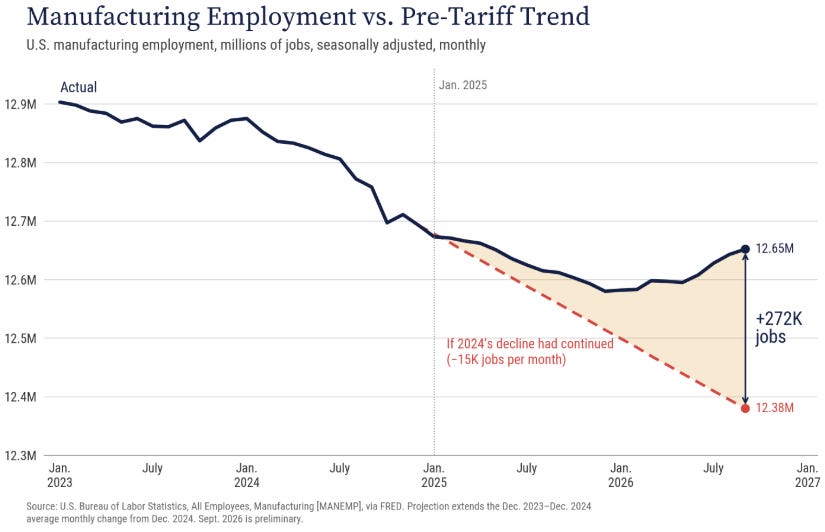
We may look back fondly on the months after Liberation Day when the cynical free traders were demanding to know why manufacturing employment had not yet surged. Where are all the magical factories that tariffs were going to conjure instantly into existence with millions of jobs?
The sector was losing 15,000 jobs per month in 2024. That rate slowed by almost half in 2025. Thus far in 2026, the sector has added more than 70,000 jobs, putting the total nearly 300,000 above the pre-Liberation Day trend. Time to move on to a new disingenuous talking point.
Axios and the Burning Glass Institute’s Gad Levanon have us covered, with U.S. manufacturing rebound not consistent across factories. Sure, “factory output rose 0.3% in September despite a 3% drop in auto production — the latest evidence that the long-struggling sector is gaining momentum,” and “the Institute for Supply Management’s manufacturing index showed a ninth straight month of expansion, with new orders growing at a faster pace and backlogs of unfinished work mounting.” But did you know, “U.S. manufacturers added a net 40,000 jobs over the 12 months ending in September. But the gains came entirely from advanced manufacturing — even though the subset accounts for just 38% of factory employment.”
Friends. What are we even doing here? Isn’t a shift toward more advanced manufacturing good? Who here thinks, if the trends were reversed, Axios and the Burning Glass Institute would be celebrating that it was other manufacturing rather than advanced manufacturing benefiting most?
Not for nothing, it’s also worth taking a look at the actual job trends on both sides of Mr. Lebanon’s divide. Both were losing jobs at a similar rate in 2024, both slowed their declines significantly in 2025, both turned positive in 2026. Advanced manufacturing employment shifted from 37.5% of the total at the end of 2024 to 37.7% today. Worrying. Very worrying.
GOOD READS FOR YOUR WEEKEND
How Evangelicals Turn Supporters into Leaders—and What the Left Can Learn (Eric Blanc, Labor Politics). If you enjoyed part one, on lessons for labor organizing from church organizing, give part two a read.
Mike Konczal writes, What distinguishes the 1% from the merely affluent? A third kid. Interesting data, and a particularly important insight: “Is this about a third kid becoming a new cultural symbol for the 1%? Some digging makes me think this isn’t the case and the story might be more fascinating. A third kid isn’t new for them; what’s new is that it has become rarer for everyone else.”
I Teach at a Business School. It’s Time to Shut Them Down. (Chris Marquis, New York Times) “The modern business school is designed to promote dealmaking, simplification and optimization. This mind-set has escaped containment and has spread to the wider world.”
What liberals get wrong about social media (Matt Feeney, UnHerd). Really wonderful essay on the convenient and shallow obsession with “disinformation” as the fatal flaw of social media, when in fact the problem is that “it is more extractive than extremist.”
h/t Matthew Crawford, who expands further in the attention economy v. free-market thinking.
Crawford wrote a related piece for American Compass several years ago, on how “attention-harvesting technologies jeopardize our capacity to govern concentrated power—and ourselves,” part of our underrated and increasingly prescient collection: Lost in the Super Market.
GOOD READS – AI DIVISION
Why the AI Pessimism? (American Compass) New polling data, conducted in two waves over the past six months. Key finding: “The strongest driver of AI pessimism is belief that AI labs do not see ‘improving everyday lives’ as a priority. Net optimism drops from +41 among the 25% of Americans who believe this is a top priority for companies to (-60) among the 22% who believe it is not a priority.”
Nobody Is Ready for the AI-Agent Flood (New York Magazine). Yet another way AI at scale seems likely to make the ordinary American’s life worse.
Coxon Day (The New Critic). Really long, but worth your time, from an extraordinarily talented young writer. “This messianic moment — complete with such biblical stakes as total annihilation, total enslavement, total absolution, or total power — has created a tribal frenzy in the Bay that will soon spill its bounds. There, you’re a good guy, or a bad guy, or you’re evil, or you’re crazy, or you’re retarded, or you’re cracked, or else you’re altogether worthless. Those uncourageous sheeple with no tribe will have to watch from the sidelines as the great battle over our civilization is waged without their knowledge or consent. If you’ve been AGI-pilled, it takes little effort to convince you that the labs, or fighting the labs, or covering the labs, are the only things that matter.’
How to Increase America’s AI Lead Over China (Institute for Progress). Good report with concrete and immediately doable proposals. “The two most important interventions are: (1) For BIS: Create a new end-use control to restrict China’s remote access to training clusters abroad — China’s largest and fastest-growing source of frontier-scale compute. (2) For DOJ/FTC: Create a narrow safe harbor to allow US companies to coordinate on countering Chinese adversarial distillation. Both interventions (and all the others we discuss in the report) are things the federal government could do today.”
BAD READS
As lame-duck battle over chips heats up, OpenAI pulls back (Politico). “OpenAI has changed its tune on China. Nvidia is a big winner.” Booo.
The Excruciating Delight That Is Modern Day Apple-Picking (Wall Street Journal). Pro-tip: You’re not going to find a real rural agricultural experience within a convenient drive of a massive modern metropolis. You can go to rural America if you want that. Or you can truck with everyone else from Park Slope out to some Potemkin orchard “experience.” But it seems odd to be surprised by, or complain about, the difference between the two.
WILL THERE BE ENOUGH JOBS FOR REPORTERS COVERING LABOR SHORTAGES?
Breathless reporting on how immigration enforcement reduces the pool of easily exploitable labor always seems to stop short of asking the desperate employers, “so, um, you’re saying that you were knowingly operating your business illegally this whole time?” But the Wall Street Journal delivers a modern classic of the genre here: The Immigration Crackdown Is Making It Much Harder to Build Houses.
The summer surge in federal immigration raids is hitting the housing market, pushing up labor costs and freezing projects.
Nearly two-thirds of builders said immigration enforcement is affecting their labor force, up from 23% in March and 13% a year ago, according to a September John Burns Research & Consulting survey.
“We’re almost dead in the water because our workforce is gone,” said Scott Brannock, president of Jacksonville-based Tidewater Homes and the Northeast Florida Builders Association. “We have national builders who are missing projections, losing hundreds of thousands of dollars because they have slabs sitting on the ground and no one to frame.
I have a follow-up for Mr. Brannock…
And even if contractors are able to find workers, the labor shortage means they have to pay them significantly more. Brannock, the Jacksonville builder, said local framers’ wages used to work out to around $20 an hour. Now, that is up to $40 to $45 an hour. For the average 2,500-square-foot house, framing labor, which used to cost $10,000, now runs builders $25,000 to $28,000, he said.
Too bad those framers aren’t white-collar professionals, then they could get a feature written about how their industry is booming, with high demand driving rapid increases in pay. Sorry guys, maybe stop building houses and start running social media campaigns or something.
Builders and subcontractors say it will be costly and time-consuming to replace workers like Velazquez with U.S. citizens. “There’s no one lining up to do a lot of these jobs,” said Josh Putnal, the owner of a siding-and-soffit subcontractor in Jacksonville.
There’s no one lining up in the parking lot at Home Depot, I think he means. See, thing is, in a healthy labor market, there’s no line of people waiting to take a job you might deign to offer. Maybe Mr. Brannock could organize a group of builders to line up in the parking lot at the Northeast Florida Builders Association and framers can swing by and pick up whoever is offering the best work.
Meanwhile, while fewer illegal immigrants are available to frame houses for $20 per hour, entrepreneurs are, wait for it, finding more productive ways to build houses. Capitalism! I don’t usually promote corporate press releases, but I’ll gladly copy-paste one written with this kind of style: “D.R. Horton is not waiting for lower mortgage rates, stronger consumer demand or relief from persistent construction labor and cost pressures to make ongoing investments and commitments to operational improvement. Instead, the Arlington, Texas-based homebuilding giant is extending a decade-plus commitment to construction and operational innovation into a new frontier: artificial intelligence that performs physical work.”
Read more about Promise Robotics, the company partnering with D.R. Horton, in this profile: Canada’s housing supply is in crisis. Can robots help? (BetaKit)
And here’s a fun video: Promise Robotics
Progress also continues apace at the The American Housing Corporation (American Compass podcast with co-founder Bobby Fijan here). Take a tour through Demonstration House 2.
But who will pick the crops? A robot is now harvesting iceberg lettuce at speeds comparable to human crews. And, interesting perspective on the traditional tinkering of farming someday extending to custom robotics as well. “Today farm robots are priced for large operations. Within 10 years, farmers will build their own.”
SOMEHOW, THE CHINA OVERCAPACITY STORY JUST KEEPS GROWING
China is tough. I don’t think they have to be a natural enemy of ours. But if you don’t have some sort of common trade barriers that are fair, it’s going to be hard to stop them.
Look at Germany. They don’t have a proper defense industrial base, but their real industrial base was extraordinary—cars, machine tools, all this equipment. That’s being attacked today by the Chinese. And their stuff is good. They’re going to lose. You can see it right in front of you, but it’s going to take a while to play out.
Right now I am shocked that the EU isn’t just totally shutting down China with what will be a $1.2 trillion surplus given that it has become an export behemoth on the backs of the workers in the EU.
After Welcoming China’s Electric Vehicles, This Country Is Paying the Price (New York Times):
Then the Chinese automakers arrived.
Today, they control about 85 percent of Thailand’s electric vehicle market, up from almost zero four years ago. Japanese automakers, slow to embrace the technology, have struggled. In 2024 and 2025, Subaru and Suzuki shut down their Thai plants, while Nissan and Honda have scaled back production.
Several Thai auto-parts suppliers that depended on Japanese manufacturers went bankrupt, threatening a supply chain that employs about 700,000 workers.
“It was much faster than anything we had expected,” said Supavud Saicheua, chairman of the National Economic and Social Development Council, the central economic planning agency in Thailand.
“We didn’t think of the full picture,” he added. “The impact on Thailand has been much more adverse than we had thought.”
Michael Dunne highlights staggering data in our own hemisphere: “Chinese cars are pouring into the Americas south of the United States. The numbers are staggering. Chinese share of new car sales in 2026 – Venezuela: 51%; Peru: 39%; Chile: 33%; Mexico: 21%; Brazil: 17%; Argentina: 12%.” And, he notes, “Thailand, Mexico, Brazil, Europe all taking a similar tack vis a vis Chinese car imports.”
MORE PROBLEMS WITH CHINA
Japan ‘months’ from running out of critical rare earth as China squeezes supply (Financial Times). “Tokyo asks US to help convince Beijing to ease chokehold on yttrium and avert manufacturing shutdown.”
Volkswagen bet on Xpeng to save its China business. It’s not going to plan (Reuters)
“China represents the challenge at the heart of Volkswagen’s global crisis: A market that once contributed nearly 50% of group profits now accounts for about 10%. That stunning reversal has forced the company into the biggest restructuring in its 89-year history.”
Stunning! Who could have guessed. Not Jensen Huang, who says of the CCP, “They also publicly say, and rightfully I believe they believe this, that they want China to be an open market. They want to attract foreign investment. They want companies to come to China and compete in the marketplace, and I believe that. The Wall Street Journal should just pre-write the obit for Nvidia’s China business so it’s ready to go when the time comes.
Can’t really say it better than Nick Phillips does here: “At root, the libertarian error is to see free trade with China as capitalism and tariffs as socialism. It’s exactly the opposite. Importing Chinese goods means importing their subsidies, their currency manipulation, and their industrial policy, letting these distortions determine prices in our country. Tariffs preserve our capitalist system by ensuring that prices reflect free competition between firms rather than Beijing’s decision to subsidize a strategic industry. The real socialists are the ones who want a socialist state to determine who wins and who loses in the American economy.”
But, I can say it more succinctly: Free Trade, Free Markets, Choose One.
THANKFULLY, THE UNITED STATES IS CHOOSING FREE MARKETS…
…even if that means escalating economic conflict.
Peter Harrell: “Interesting US sanctions out this morning against a Chinese startup accelerator (sort of like a Chinese Y Combinator), over IP theft. Signal that despite Trump-Xi summitry and the trade truce, enforcement action against specific harmful Chinese activities continues.”
And the Treasury Department signals its intent to tighten outbound investment restrictions with a new notice of proposed rulemaking: Outbound Investment Security Program Regulations. Bill Bishop comments, “Likely lots of heartburn for some VCs and Pharma firms tonight. Surprised the lobbyists were not more successful.” Chris McGuire has the details.
For its part, China Slaps Export Curbs on More Drones and Industrial Machinery (Bloomberg). “China is imposing export controls on more drones and machinery, as the world’s second-biggest economy flexes its industrial muscles. The measures announced by the Ministry of Commerce Monday will take effect from Nov 18. They expand curbs to include new types of drones — plus parts and technologies — as well as components of dredgers including mud pumps and cutterheads. Also added to the list are some types of tunnel boring machines, which hadn’t previously been subject to export controls.”
As Eurasia Group’s Gerard DiPippo points out: “Those advocating for Chinese FDI into the US on the grounds that it will allow more tech transfer into the US should pay closer attention to China’s export controls. Beijing won’t let that happen for important technologies, even if Washington were interested.”
…AND SO WHILE THE REST OF THE WORLD COPES WITH CHINESE-INDUCED DEINDUSTRIALIZING, WE ARE DOING THE OPPOSITE
Check out IndustriousAF, an organization at the intersection of venture capital and workforce development. “The founders we work with say their tightest constraint is trained talent. There are not enough pathways (like apprenticeships) connecting people to these careers. We are building them, starting on the shop floor.” They’ve just released a valuable tool called Promised vs. Produced, designed to provide quarterly tracking of investment commitments coming in from the loading docks and new production rolling off the assembly line.
Co-founders Ashwin Lalendran and Brent Parton join me on this week’s American Compass Podcast.
Welcome back, Defense Policy Board, now chaired by the great Bob Lighthizer. Politico:
The revived Defense Policy Board will meet today at the Pentagon for the first time under its new chair, former U.S. Trade Representative Robert Lighthizer. The agenda for the closed-door, two-day meeting has a strong trade flavor as participants explore the defense implications of U.S. trade and economic policy.
The Defense Policy Board has historically not focused on trade,” Jeannette Chu, vice president for national security policy at the National Foreign Trade Council, told Morning Trade, adding that the meeting’s agenda reflects the administration’s economic security priorities as laid out in the National Security Strategy. That “includes seeking balanced trade, secure access to critical supply chains and materials and reindustrialization.”
Economic security is important to national security, imagine that.
JPMorganChase has begun doing the actual investment part of investment banking.
Robot factories and hypersonic missiles: JPMorgan Chase’s first $5 billion of defense investments (CNBC).
Jamie Dimon’s National-Security Pledge Finances $230 Billion in First Year (Wall Street Journal).
More good stories.
Major rare earths processing plant to be built in New York (Politico). “The Pentagon-backed facility in Rochester by Phoenix Tailings would be among the world’s largest rare earths processing facilities outside China.”
Apple adds iPhone component, materials makers to its US supplier network (Manufacturing Dive). “Apple has partnered with a new U.S. supplier and expanded its alliance with another to provide critical materials and components for the iPhone Duo and iPhone 18 Pro, according to an Oct. 20 press release. Apple’s new supplier is Perryman Co., a Pennsylvania-based titanium producer. The metal is used to make the casings of many Apple products. Apple will commit up to $100 million over the next three years with Perryman, which melts, forges and rolls titanium with at least 80% recycled content for iPhone Duo, according to the release.”
And one more good weekend read, on The Family Firm That Has Never Had a Layoff in 75 Years, for those of you who have made it all the way to the end (Wall Street Journal):
Hundreds of executives have made the pilgrimage to St. Louis to try to replicate Steve Gund’s elusive feat: He’s the third-generation CEO of a family manufacturer that has averaged 18% annual growth for a decade—all without ever laying off an employee.
…
The model requires trade-offs, and a lot of discipline: Gund has never had a layoff but staffs sparingly so it can weather the leaner stretches. Employees are pushed to voice and document concerns on red cards displayed on the factory floor, putting leaders on notice to take care of problems quickly. Everyone from line workers to managers crafts a career-development plan. Yet those who don’t adapt to Gund’s high-performance culture are managed out.
OK, OK, we all know the real reason you read to the end… it’s time for:
THIS WEEK’S CANADA GOOSE!
We met former Canadian Finance Minister Chrystia Freeland a couple of weeks ago, interviewing Janet Yellen about how “it’s important for Canada and other countries not to accept this lying down and to retaliate.” But this week she joined The Ezra Klein Show for one of the more distant-from-reality conversations on record. The episode, “Trumpism Is Backfiring,” begins from Klein’s premise that:
In late August, Prime Minister Mark Carney, of Canada, walked away from trade talks with the Trump administration. He did so knowing that the retaliation could be ruinous for the Canadian economy.
But it’s also ruinous and revealing about the shambles of Donald Trump’s foreign policy — how what Trump is doing is not getting America what Trump wanted. I mean, Trump wanted Canada to be the 51st state. Instead, it might become an associate member of the European Union.
Trump wanted to weaken China in the global sphere. Now Carney and Canada are negotiating deals and agreements with all manner of other countries, including China, in an effort to diversify away from America.
Canada’s actions are “ruinous” for Trump’s foreign policy because he actually wanted it to become the 51st state and now it’s going to be an EU member? China has not been weakened because… Canada wants to negotiate with it? What a peculiar weighting of priorities, giving so little value to successful U.S. deals concluded with every other ally that a single tantrum from Canada earns a grade of “ruinous” failure overall. The actual conversation is about as helpful as you’d expect from one that starts there. No, you won’t learn from Ms. Freeland why Canada walked away or how joining the EU would better protect its “sovereignty.” But you will learn:
It even got to a point where Cecilia Malmström, a wonderful Swedish liberal, was the E.U. trade commissioner. She was dealing with the U.S. I was, too. We would text each other and talk to each other, and we developed this shorthand where, if you said: I am in Mordor — that meant: I’m in Washington. Cecilia once sent me a text saying: Gandalf is going to Mordor next week.
Obviously, to me, what that meant was that Angela Merkel was going to Washington. In the shorthand, the elves were Europeans. Hobbits were Canadian.
Truly, Andrea Merkel was the Gandalf of her time…
Hard to top that, but I did appreciate this from The Economist as well: “One big problem is that the middle powers are a disparate bunch, with differing degrees of nostalgia for the order that Mr Carney mourns.... Such regional heavyweights as Brazil, South Africa or India are not sure who appointed Canada—a blandly rich vanilla milkshake of a country—to lead a new post-American world order.” An editor should surely have caught “blandly rich” but, otherwise, well played.
Enjoy the weekend!
I chuckle every time I see the "new" right ape Joepa's effort to sell Bidenomics. Ole Joe likewise liked to lecture voters the economy was going swimmingly, and of course there are always stats to pluck to make a case. Don and Oren likewise plead with the workin stiffs to ignore their everyday, real-world experience, ignore the gravy train the Epstein Class is riding, and embrace DonOrenomics. Ironically, Don's numbers on the economy have sunk even lower than Joepa's, especially in the ag and manufacturing states most directly impacted by the taco tariffs and MAGA's Canadian and Middle East wars. I'd be nervous too if I was Oren:).
Nothing frosts me more than the ignorance or willful deflection of the media and economists over the leading economic indicators of an industrial and manufacturing boom that is clearly the direct result of the Trump, Bessent, Lutnick and Warsh team agenda. Thank you for this.