



Democrats are beyond euphoric at the results of the November midterms. And why shouldn’t they be? They picked up as many as nine Senate seats and 45 House seats, giving them potential congressional majorities of 56-44 in the Senate and 259-176 in the House. Democrats carried the House popular vote by around 13 points, a massive 14.5-point swing from 2024.
Democrats thus feel they’re well and truly back after enduring two brutal defeats at the hands of their archnemesis Donald Trump. Prediction markets strongly favor a Democratic victory in the 2028 presidential election, and many Democrats hope for a long-term realignment that will marginalize Republicans for years to come.
Yet there are reasons for skepticism, especially in our “politics without winners” era. Both of our major parties have established a habit of attaining power and then going far beyond what voters will support. They overreach, then get thrown out on their ear two or four years later.
The 2020s are a perfect illustration of the overreach phenomenon. President Biden got elected in 2020 as a moderate who would restore normalcy to the country after the chaotic first Trump administration, the disruptions of the COVID-19 pandemic, and a sharp economic contraction. But his administration instead emphasized the Democratic cultural priorities on race, gender, and immigration while running into a buzzsaw of inflation and government dysfunction.
Voters rejected all this and turned back to Trump in 2024, hoping to get the economy, border, and culture under control. Trump then proceeded to go far beyond his own mandate, from the excesses of DOGE and ICE to an endlessly shifting tariff regime and the highly unpopular Iran war. Meanwhile, the cost of living seemed to get worse, not better. This was overreach with a vengeance. So, out went the Republicans and in come the Democrats.
The obvious lesson for the Democratic Party is: don’t overreach! This is simple to state but hard to do. Here are some of the pressures Democrats will face.
1. The election was a rejection of Trump, not an endorsement of Democrats. Smart observers acknowledge this fact, but the temptation will be great to assume voters supported the broad Democratic agenda. In reality, their mandate is simply to be “not Trump,” undo some of the damage he has done, and (somehow) make life more “affordable.” Support for “bold” programs, or really any specific program, is questionable. But that won’t stop many of the loudest Democratic voices from making a racket.
2. It’s still a Brahmin Left party. Democratic support among the college-educated spiked to new highs in the midterms. Averaging the two main data sources, the New York Times Voter Trends and the AP-networks Voter Poll, we see a 27-point advantage for the Democrats among college graduates. There was also a surge in support for Democrats among working-class (non-college-educated) voters, producing a 1-point Democratic advantage across the two data sources, probably the party’s best performance among this group since 2018. That brought the Democratic class gap (college-educated minus working-class support) down slightly, to 26 points from 27.5 points in 2024.
But that’s still a massive class gap, and it indicates that the Brahmin Left character of the party remains intact. Since the priorities of both parties are shaped by their support base, we should expect Democrats to favor those of their college-educated, mostly liberal, voters, which will make it difficult to keep and grow their working-class support.
As analyst Jared Abbott points out, had non-college voters kept their 2024 margins, Democrats would have won the House popular vote by only about 4 points, and they would not have won the Senate. Keeping gains with this group would be huge for the Democrats—if they can avoid overreach.
3. The missing Trump voters. Most analysts agree that Democratic gains were heavily driven by what’s known as “differential dropoff.” In effect, 2024 Trump voters were more likely to sit out the midterms than were 2024 Harris voters. But most of these Trump dropoffs are likely to return in 2028, so Democrats have to be careful not only to keep to their 2026 voters but also those who did not vote in their blowout victory.
4. It’s really hard to deliver “affordability.” If there’s anything voters will remember from Democrats’ 2026 campaigns, it’s their promise to address affordability. Now the party is up to bat and, awkwardly, there’s little they can do to deliver on that promise despite controlling both chambers of Congress. Senate Republicans can still filibuster, and President Trump can veto any bill.
Therefore, Democrats will need to concentrate on bills with modest, popular goals like restoring Medicaid cuts and Affordable Care Act subsidies. Then, should such bills be filibustered or vetoed, Democrats can plausibly argue that Trump and his party are standing in the way of affordability. Of course, that’s not as good as materially affecting the cost of living, but it may be the best they can do.
Accepting this will be hard. Many Democrats dream big and see their newfound power as a way of highlighting bold, transformational programs, such as universal child care and a trillion-dollar investment in affordable housing, which have no chance of becoming law but if pushed would simply highlight their commitment to spending lots of money. Pramila Jayapal (D-WA), a leader in the Congressional Progressive Caucus, has argued that a cautious approach “does not work in a moment when the country is desperate for real bold leadership.” She criticized Hakeem Jeffries (D-NY), the likely future House speaker, for bailing on her Medicare for All bill, which he once supported. “He can be at the front of that and I hope he is,” she said, “otherwise it will turn into a fight.”
Similarly, House Progressive Caucus chair Greg Casar (D-TX), has promised weekly votes on major progressive legislation ranging from wealth taxes to universal paid vacation, family and sick leave, enthusiastically saying “I want us to be passing so much.” This, of course, will do nothing to deliver on Democrats’ affordability promises but will reinforce voters’ perception that the party still leans heavily to the Left.
Even as Democratic Senate candidates pulled off surprising victories in a series of red states, more voters still said the Democratic Party was too far to the Left than said the Republicans were too far to the Right.
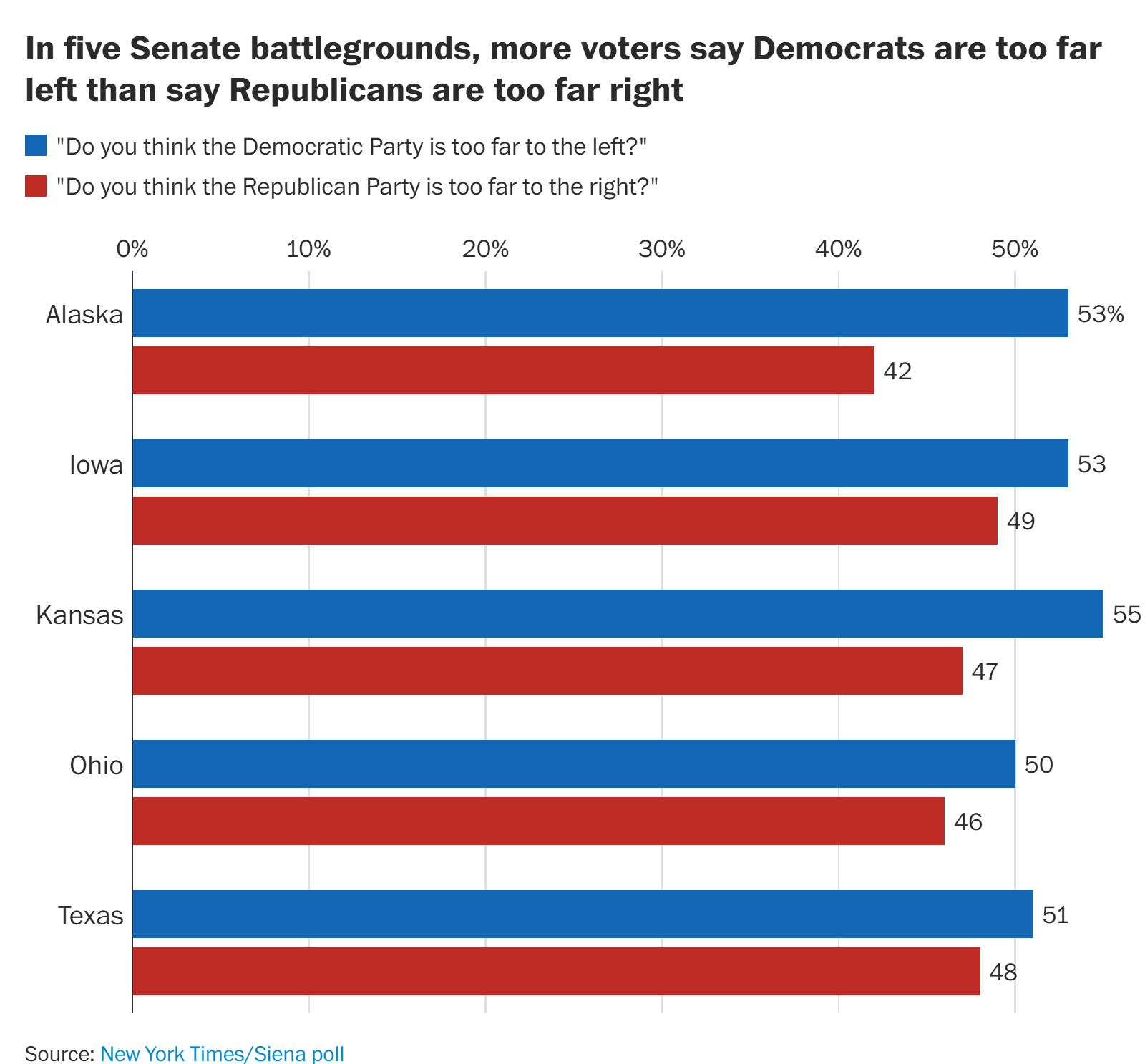
Changing that perception will not be easy.
5. The far Left will not go gentle into that good night. The Democratic Party’s Left wing feels vindicated by the midterm blowout, arguing that the party’s increased identification with the Left has only produced success. As Alexandria Ocasio-Cortez (D-NY) exuberantly put it before Abdul El-Sayed won his Senate seat, “if Abdul can win in Michigan, anybody can win anywhere.”
If that’s the attitude, why should the Left back down? Sure, you can counter that moderate-coded candidates performed better (that is, showed more improvement relative to 2024) than progressive-coded candidates. And you’d be correct. But that will not convince progressives who won anyway to sheath their swords. The Congressional Progressive Caucus should have over 105 members in 2027 and 2028, including a greatly expanded Democratic Socialists of America presence. This is significantly less than the centrist New Democrat Coalition, which should have over 140 members. But it is more than enough to cause trouble and demand concessions.
6. The Democrats are still a very liberal party. Speaking of moderates, most of them are actually pretty liberal. Their moderation, such as it is, reflects the willingness of candidates in conservative areas to dissent slightly from party orthodoxy, especially on cultural or climate issues, to achieve sufficient marketability with swing voters—what I have dubbed the “minimum necessary heterodoxy” (MNH).
This was a successful strategy in the 2026 elections. But the underlying positions, on close inspection, tend to be carefully hedged and hardly indicative of a direct challenge to party orthodoxy. This means that the Democratic Party’s center of gravity will continue to be very liberal and provide plenty of opportunity for overreach.
7. Democrats are still committed to the green energy transition. Over the course of the twenty-first century, Democrats have gotten more and more aggressive about combating climate change and promoting a rapid clean energy transition, claiming that green energy is not only virtuous but will boost the economy. That has not been the case, however, and many of their policies have been rolled back with little negative reaction from voters.
Democrats are unlikely to give up on their obsession. Climate and environmental NGOs are determined to claw back the Inflation Reduction Act provisions abrogated by the Trump administration, including the extremely unpopular electric vehicle credits. More generally, climate catastrophism and hostility toward fossil fuels are the reigning philosophy of these groups and their many Democratic supporters. The electorate did not vote for any of this in 2026, so any indulgence here would overreach their thin mandate, particularly when it comes to working-class voters.
8. Democrats do not have a viable immigration policy. Democrats are sure they oppose the actions of Immigration and Customs Enforcement, and many simply want the agency abolished, but not much else is clear about their immigration policy. Can they keep the border closed? Do they want to? How will they handle asylum claims and irregular immigration pathways such as Temporary Protected Status and parole programs? Are they willing to deport any illegal immigrants aside from violent criminals? Or do those who are not violent criminals simply get to stay here forever (which is really a soft version of open borders)?
Democrats will be under enormous pressure from the Left to move immigration policy back toward Biden-era openness. But doing so would clearly overreach their “not Trump” assignment from voters.
9. Democrats have not given up on DEI. Trump moved aggressively against diversity, equity, and inclusion programs after taking office. Left-wing activists and advocacy groups will aggressively lobby to bring all of this back, despite the basic unpopularity of affirmative action and DEI-based hiring preferences. Can Democrats resist this pressure, especially given that almost nobody in the party has been willing to dissociate themselves from these programs and take a clear stance for merit-based outcomes?
Maybe not, as Representative Ro Khanna’s notorious “DEI is back” tweet illustrates. Adopting Khanna’s attitude would constitute classic overreach.
10. Democrats are not interested in moderating on the transgender issue. The party is far out on a limb on issues ranging from biological boys and men in girls’ and women’s sports to medicalization of minors for gender dysphoria. These policies, and the embrace of gender ideology that underlies them, are massively unpopular but have become more or less the Democratic Party’s official position. Even mild heterodoxy is rare, tolerated only as a campaign tactic in conservative districts. Many Democrats are champing at the bit to push back on Trump’s restrictive actions—even in the wake of successful transgender sport bans approved in the very midterms that brought the party back to power. Voters have not signed up for a new “trans rights” crusade.
This speaks to a wider issue with “culture war” politics. Many Democrats believe that cultural matters are but a smokescreen for the machinations of the billionaire class, which explains their maniacal focus on “affordability.”
This is woefully wrong and shows how clueless—and condescending—many Democratic professional-class liberals are about working-class voters. It is also highly flawed: a massive research study by Jared Abbott and Joan Williams found that “embracing cultural positions that resonate with the working class” would be the biggest contributor to Democrats winning back these voters—yes, even bigger than prioritizing working-class economics.
11. The Democratic presidential primary could make everything worse. Democrats, of course, are well aware of the limitations of just controlling Congress. They really need the presidency. Moderate Democrats are hopeful that a candidate with broad appeal will emerge from the scrum and reset the party’s brand.
That could happen. But overreach could also rear its ugly head. Democratic primary voters skew very liberal and are unlikely to search for a candidate who, well, would avoid overreach. That’s borne out by data from an early 2026 Third Way poll of likely primary voters. The poll found overwhelming support for some moderate reforms, but also for a host of highly progressive proposals that would be a hard sell outside the partisan ranks.
These include: “Creating an annual nationwide wealth tax on billionaires” (91% support); “Passing Medicare for All, meaning that the government provides everyone’s insurance and private insurance is eliminated” (83%); “Passing a national plan like the Green New Deal that would move rapidly to eliminate fossil fuels” (74%); “Cancelling all student debt and making college free” (72%); and “Abolish ICE and halt all immigration enforcement inside the country” (59%).
This shows clear and significant support for highly progressive proposals—which could prove more exciting to liberal voters than to moderate ones in a heated primary contest. Indeed, in the same poll Democratic primary voters express support for the party becoming more liberal to beat Republicans (55%) and say that only a “true progressive” could excite them as a candidate (62%). Thus, the Democratic primary electorate could wind up backing a candidate who goes far beyond the wishes of midterm voters and, critically, the 2028 general electorate.
These are the dangers that Democrats will have to avoid if they wish to take back the presidency in 2028 and maybe, just maybe, bring an end to the politics-without-winners era. It’s possible, but their challenges are daunting, and the sheer size of their 2026 victory could make discipline all that much harder between now and the next elections.

I was reading today in the paper of record on how the parties need to adopt a populist economic agenda, especially Democrats if we want to hold onto the big majorities and take the Presidency. The article was saying it's a place where centrist and lefty Dems can come together, I read on with interest.
Something health care, maybe passed via the budget resolution process avoiding filibuster and veto. Also socking it to the billionaires. (remember "sock it to me baby" or is that before most people's time)
Basically next to nothing. Medicaid expansion back in would be good for low income, the big thing would be premium support for the upper middle class. Unmentioned is student loans, because if there is one constituency that is very Democratic it is the downwardly mobile college grad. Nothing for the vast middle who have no kids, and want a new house.
I don't see it. Falling behind is now reaching up well into the middle class with housing, job insecurity, job loss, etc. Some kind of billionaire bad is not going to filter down to paychecks. People have health care, it's just that they still can't afford the co pays and deductible.
I've heard of no big ideas with wide appeal to run on in 28, none. Still time for a third party.
https://www.nytimes.com/2026/11/12/us/politics/democrats-majorities-economic-populism.html?unlocked_article_code=1.P1E.LTAx.zdjulGItkday&smid=url-share
"Lawyer up!!'
Overreach-- ya think?