


“My train left the golden wheat fields and the tall green corn of Iowa for the acres of cotton, nothing but cotton,” George Washington Carver noted keenly about his first trip down to Tuskegee, Alabama, in 1896. “The scraggly cotton grew close up to the cabin doors; a few lonesome collards, the only sign of vegetables; stunted cattle, boney mules; fields and hillsides cracked and scarred with gullies and deep ruts ... not much evidence of scientific farming anywhere. Everything looked hungry: the land, the cotton, the cattle, and the people.”
Cotton was king, or perhaps dictator, of the early-twentieth-century Southern economy. It grew “close up” to the cabin doors because nearly every square inch of land on many Southern farms was dedicated to the crop. The cotton harvest was crucial to paying off debts and buying anything a farmer might need, though more often than not it became a source of more debt, with a poor season seeing many Southerners lose control of their land. This was especially true of black farmers, who faced the daily realities of the Jim Crow system along with the economic monoculture. But the cotton stranglehold wasn’t merely an economic issue. Carver’s word “hungry” was apt for all the reasons he described and more.
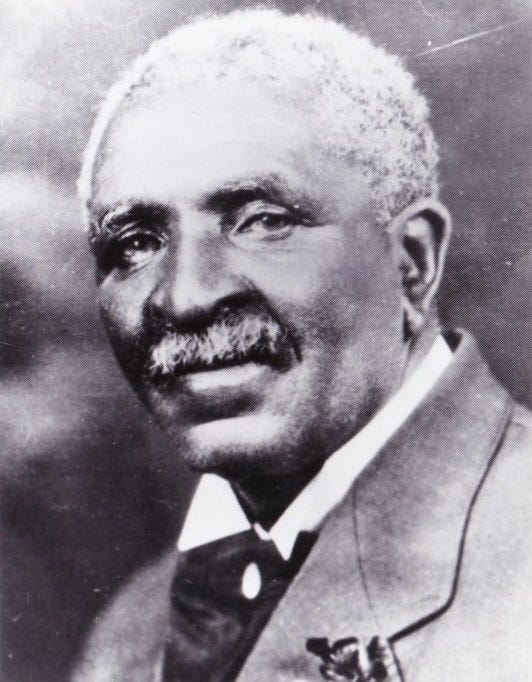
George Washington Carver.
Despite romantic notions of vegetable-rich farm diets prior to the advent of processed foods, the Southern cotton farmer’s diet could not be described as healthy then or now. It had three main ingredients that became known as the “3 Ms”—meat, meal, and molasses—to which the addition of the humble peanut could add invaluable nutrients and protein. Well into the twentieth century, many rural Southerners suffered from a disease called pellagra, which gave its victims a painful skin rash and was often fatal. A doctor named Joseph Goldberger discovered that pellagra was caused by protein dietary deficiency. Thus, Carver had become determined to get other crops onto those hungry cotton fields, and he knew the task would be colossal.
Carver was a plant whisperer from childhood, and his fascination extended to all plants, ranging from vital cash crops to roadside scrub trees. Over time he narrowed his focus to soybeans, sweet potatoes, and especially peanuts. Carver’s main goal was to diversify farmers, particularly black farmers, out of cotton’s grasp. Peanuts proved up to the task.
Because cotton was so ingrained in the Southern economy and the Southern mind, Carver at first promoted peanuts as a cotton booster. The two plants thrived in different seasons, meaning peanuts could be grown on the same acreage as cotton without harming the coveted white cash crop. More to the point, Carver discovered that peanuts added nitrogen to the soil, which in most of the region had been badly depleted from the lack of crop rotation.
The scientist toured Georgia and Alabama aboard something he called the Jessup wagon, a horse-drawn laboratory and classroom of sorts that he used to demonstrate soil chemistry to cotton farmers. Thus, peanuts could be viewed as the mere byproduct of a soil replenishment technique. A separate obstacle for Carver was convincing farmers that peanuts themselves were worth having around, as many didn’t know what to do with them after the harvest.
In fact, neither did Carver. This dilemma is what set him on his quest to identify and cultivate uses for peanuts, a list eventually totaling hundreds of items. Less well known is the event that rocketed Carver to stardom. Domestic peanut farmers faced stiff competition from Africa, with peanuts imported from the continent as early as 1835, especially to the industrial Northern states. By 1841 the African peanut trade had developed into a decent business with a value of £8,127, with shipping expeditions all the way to and from West Africa for the express purpose of obtaining legumes.
A modest tariff was imposed in 1842, but it did little to slow the trade. Europe also thrived on African peanuts in the 1800s, with England, Germany, and especially France importing shiploads of peanuts that were converted into peanut oil for use in margarine, soap, bread, cakes, cattle feed, salad oil, and even grease for industrial machinery.
How does all of this involve Carver? Because he played a direct and outsized role in ending peanut imports into the United States, aiding domestic growers in the process. The commercial use of peanuts surged during World War I, providing a boon to peanut-growing areas. In 1919, shortly after the war, the city of Enterprise, Alabama, famously erected a statue to commemorate “Billy Boll Weevil” for helping it diversify into peanuts. That progress was threatened the very next year, however, when foreign peanuts from Africa as well as China and Japan flooded the domestic market.
American farmers demanded a heavy tariff to protect their nascent peanut profits. In 1921, the House Ways and Means Committee held hearings on a potential peanut tariff, inviting a host of industry experts, Carver included, to testify. His appearance was expected to be a rather sleepy affair before a staid congressional committee, but it instead played out like something from an inspirational film.
Carver was the only black speaker and was scheduled to speak last. The committee was bored with peanut talk by the time he appeared, and the chairman reminded Carver that he had just ten minutes to present. Carver then calmly laid out his “pandora’s box” of 101 different uses for the peanut. He faced some harsh initial questions from the chairman, including rude asides likely related to his race, but Carver responded not only with grace but with wit and humor as well. When his ten minutes were up, he was instructed to continue.
Carver pulled out chocolate-covered peanuts, peanut candy bars, peanut ice cream, peanut
cakes, peanut flour, and peanut meal, taking bites of some items to show off how delicious they were. He displayed for the committee five breakfast foods made from peanuts, plus peanut-based livestock feed, peanut milk, peanut-based mock meat, peanut soy sauce, and peanut Worcestershire sauce. There were peanut-based face creams and powders, wood stains, and ink. Carver got a standing ovation when it was all over, and Rep. John Nance Garner, a Texas Democrat who would later serve as Franklin Delano Roosevelt’s first vice president, described it as the most wonderful exhibition he had ever seen before the committee.
Remarkably, Carver did not ask for a tariff during his nearly two hours of demonstrations, or not directly, anyway. He was questioned on the topic by one of the congressmen and responded, “Tariff? This is all the tariff means—to put the other fellow out of business.” The quip drew plenty of laughter, yet Carver reiterated the point in a letter he sent the committee afterward, writing, “My appearance was not to discuss the tariff. I have nothing to sell; I will manufacture nothing. I simply came to add my little bit if possible.” He then added, tongue in cheek, “I feel sure you gentlemen will guard and put proper restrictions upon every interest that arises in harmful competition with ours without any suggestions of mine.”
America’s peanut growers got their tariff—and at three cents a pound for unshelled peanuts and four cents a pound for shelled peanuts, it was the highest the industry had ever seen. Peanut farmers lavished praise on Carver in their trade magazines, and the scientist promptly hit the lecture circuit, speaking about peanuts in Chicago and New York City en route to becoming one of the most famous figures of his day and a fixture of school history lessons for at least another century.
With the tariff in place, the stage was set for massive growth in the American peanut industry, which aided farmers across the South. The wider economic impact beyond the farms was less obvious at first. The challenge remained finding practical, everyday uses for the crop that could be consistently and repeatedly sold. Carver found 300 different uses for the peanut, but he never commercially produced any of them at scale. The legendary scientist was a demonstrator, an educator, a booster even. He was not a businessman, however, typically celebrating the potential of non-cotton crops rather than developing that potential himself. He was glad to help when asked, though.
The tariff was tremendously well timed, coming as it did at the beginning of the agricultural depression of the 1920s. Southern farmers often lived in unpainted shacks, traveled in wagons over unpaved roads, lit their homes with oil lamps, and drew water by hand from wells. Cotton
prices fell by half from 1919 to 1920 and did not recover at any time during the next two decades. For many Southern cities, the death grip of cotton largely remained in the form of cotton mills that dominated the skyline, the riverfront, the employment landscape, and even the realm of politics. Competing employment opportunities were often scarce.
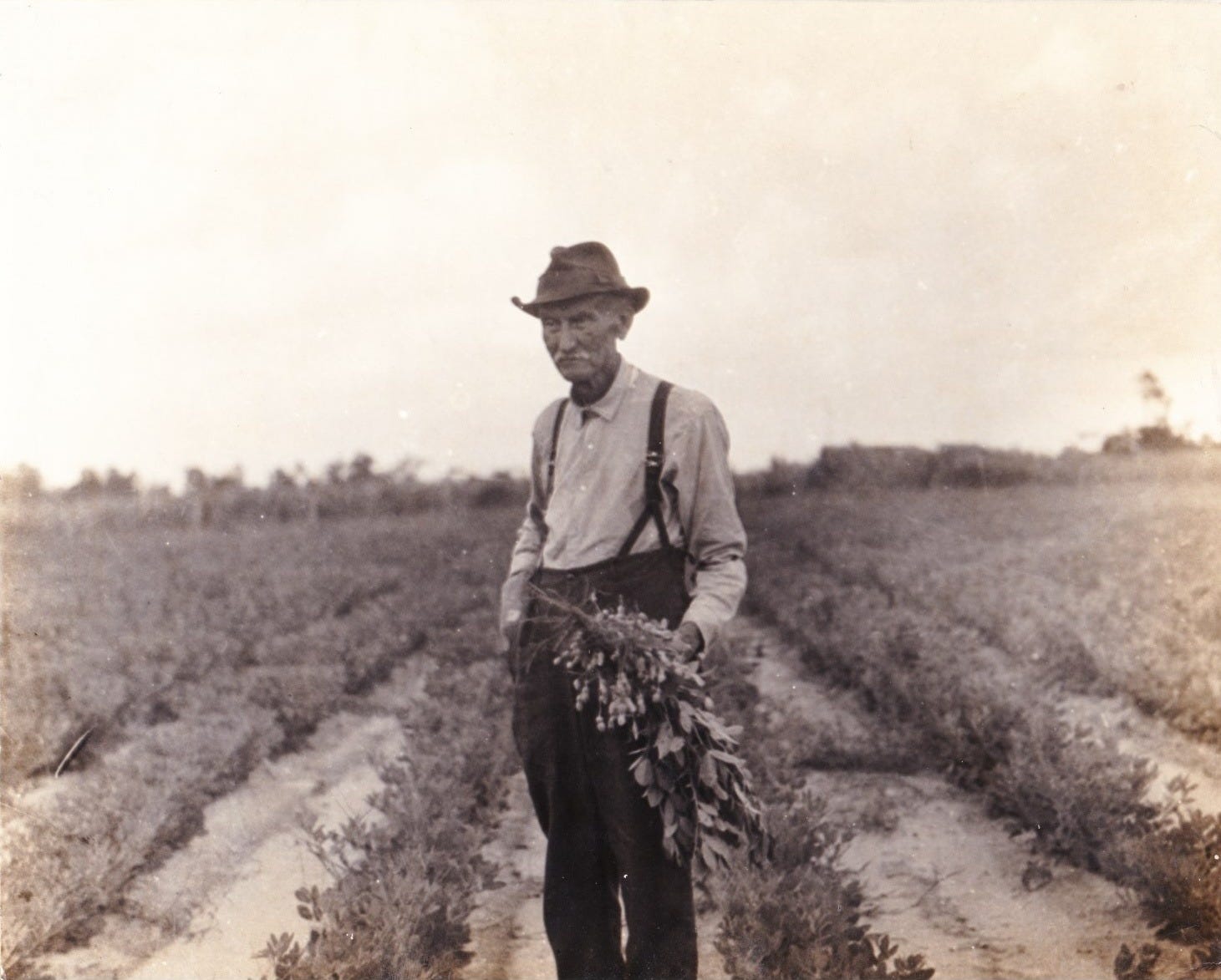
An early-twentieth-century peanut farmer.
Mill hands in the South could expect to earn half the wage of their New England counterparts, and they’d learned through a series of mostly unsuccessful and often violently repressed organizing efforts that union drives were not going to bring a quick remedy.
But change was coming, if slowly and gradually, thanks to new technology, entrepreneurship, the protection of the tariff, and a spirit of progressivism following the Allied victory in the Great War. Carver later found kinship with a Columbus, Georgia-based inventor and peanut promoter named Tom Huston, and with a plan he’d later describe as among the most interesting he’d ever seen.
An Unlikely Partnership
Three years after Carver’s appearance before Congress, and with the peanut tariff in place, he received a letter from Huston, who lived 45 miles away on the other side of the Georgia-Alabama border. Huston had made a name for himself by inventing a series of peanut shellers that grew to dominate the market in the lower peanut belt. Farmers who could not afford to buy a sheller often brought their harvest to his company, Tom Huston Manufacturing, and some of Huston’s payment from these cash-strapped farmers came in the form of their peanut crop.
His next task, then, was to sell the peanuts piling up at his factory. To increase business for his peanut shellers, Huston knew that making peanuts more appetizing and popular was crucial, and he sought an innovation to capitalize on the boost in production.
Huston began to think out improved ways to toast, season, package, and sell peanuts. In 1924 this quest led him to write Carver. Huston told Carver that he’d learned how to keep peanuts edible “almost indefinitely” by placing them in an airtight bag. Huston asked for advice on the cooking and seasoning process, inquiring how one might put salt and oil “inside the peanut” rather than on the outside, where they got all over the consumer’s hands. He included a small sample of salted peanuts, and as an aside, Huston mentioned that most of the peanut shellers in the South were his models.
Carver was hooked right away. He wrote back five days later to say that he read Huston’s words “with a great deal of interest ... in fact with much more interest than usual,” and he confirmed that he’d like to set up a meeting. Carver continued:
I am very much interested in what you propose and you have certainly made a great contribution to the industry as this has been one of the greatest. I have received the package of roasted nuts also. … I must say they seem to me the most delicious that I have eaten. If you could succeed in getting the oil into the nut, it would be a wonderful addition. I really believe it can be done but will require a great deal of experimental work. I shall be glad to give some attention to this when I can get to it as I am very much interested.
Huston followed up just two days afterward, proposing that the two meet at the Montgomery Fair, which was scheduled for November. All indications are that they did meet at the fair and became fast friends. The next year, Huston launched his innovation: a patented, packaged product known as Tom’s Toasted Peanuts that quickly became a national sensation. He sent samples to Carver, who shared them with the Tuskegee Institute (now Tuskegee University) Board of Trustees. “It was equally as interesting to hear their comments, which were exactly the same as mine,” Carver wrote, “the best they had ever eaten.”
The public agreed. By the end of the 1920s, Huston was selling 2.25 million bags a week of Tom’s Toasted Peanuts and employing 400 people in a Columbus factory, along with 150 independent distributors hawking peanuts in two dozen states. His firm attracted the attention of the New York Times and TIME magazine, which marveled at his success. In the summer of 1929, Huston was offered $4.4 million for the company (roughly $87 million in 2026 dollars) by a New York syndicate, though he turned it down hoping to grow the firm even larger on his own.
The Huston/Carver relationship evolved over time, and by the end of the decade Carver was communicating more with Huston’s employees than with Huston himself. The mission shifted as well, away from the challenge of creating a popular peanut-based product and toward new battles that accompanied rapid growth.
Ultimately, Carver and the Tom Huston Peanut Company collaborated with great success on the latter initiative, one arguably more difficult and certainly more sprawling in scope than the former. The biggest new challenge lay in fighting peanut plant diseases and getting the United States Department of Agriculture and powerful land-grant universities to focus on and fund research into peanuts. It was a long journey.
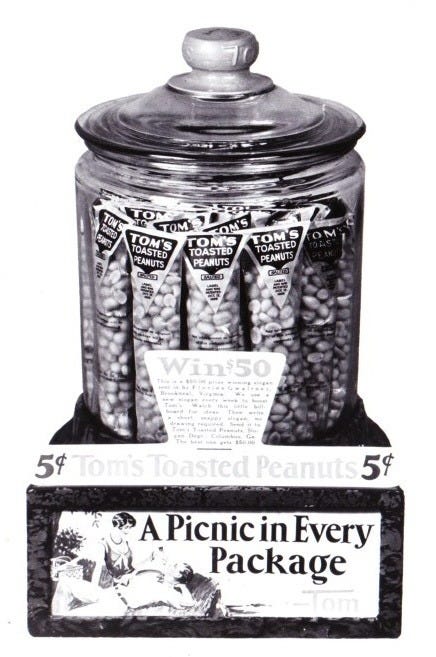
Tom’s Toasted Peanuts launched in 1925, and by 1929 more than 2.2 million bags were being sold per week.
Domestic peanut production rose almost 40% between 1925 and 1930, and consumption totals broke records while imports fell by more than half. Aiming to preserve this growth, Carver wrote extensively to Tom’s field manager Grady Porter and especially to shelling department manager Bob Barry. The USDA at the time studied cotton and soybeans yet was doing little if any peanut work, leaving Tom’s (as the company became known) to fill the void by conducting its own research and even preparing its own brochures and public relations campaigns to teach farmers the best way to maximize their peanut crop.
Though Tom’s never grew peanuts, only purchasing them, it was so dedicated to business growth that it sold its own branded seeds and conducted peanut crop research on company-owned acreage to increase the size and quality of yields. By September 1929, Carver was predicting big results. “‘The Empty Dinner Pail’ is one of our greatest national problems,” he wrote on September 23. “Your great commercial and educational institution will make a great contribution to this and by giving and demonstrating to the world how easy it is to get a cheap, wholesome, nutritious, appetizing, well-balanced food stuff from the peanut.”
The team of two white men and one black man worked closely together despite the limitations of the segregated South. “We feel that you are more competent to work this out than anybody we know,” Barry wrote to Carver on August 16, 1930. “Our Mr. Porter should be able to take you to one of these fields, without any expense to you at all, and bring you back the same day.” Carver wrote a lengthy letter to Porter two weeks later in which he discussed peanut diseases, adding, “I shall consider it a great privilege to cooperate with you and Mr. Barry in any way I can in your efforts to suppress these diseases which threaten one of the South’s great money crops.” Barry and Porter traveled to Tuskegee, and Carver made a return trip to Tom’s headquarters in Columbus within the same month.
Portions of Barry’s letters reveal a distrust of government officials generally and of the USDA in particular. On September 16, 1930, he wrote to Carver that his mind was going around in circles over how to combat peanut diseases and sell the idea to government agriculture officials.
“Possibly some high official in the Department of Agriculture in Washington could be startled into an appreciation of the seriousness of the situation,” Barry wrote. “He could call a meeting of the agricultural powers of the Southeastern States and learn all the details of your discoveries. It might be the rest of them would boo at the situation because somebody else found it out. Then too people in political jobs are not looking for hard work as a rule.”
Carver often felt the same as Barry about D.C. One day prior to Barry’s letter, Carver wrote to his longtime friend Dr. M. L. Ross: “All last week I was called upon to inspect farms of peanuts in Ga. Ala. and Fla. A very serious disease has appeared among them. They have had it before the leading experts in Washington D.C. and many [Experiment] Stations, they knew nothing about it. I happened to know what it was from experience.”
Barry did, however, trust Carver. He once wrote him three letters in a single day and often complimented Carver in their correspondence. Barry praised Carver as “so much more competent to do this than we are,” saying he wished Carver were “either twins or triplets” because his work was so valued, and made it clear that Carver had decision-making power.
Together, the Huston-Carver team published its own books, magazines, and pamphlets on peanut cultivation, which were mailed out to thousands of peanut growers, shelling plants, and county extension agents in the region, plus newspapers, banks, and relevant figures in Washington. The reports included sections on both the problem—peanut diseases and how to identify them—and the solution, a set of recommendations that Carver wrote with advice on where and how to plant the crop.
In the end, the men did attract the attention of the USDA and the region’s powerful land grant universities, so much so the pace of their letters slowed considerably by the end of 1932 as government-backed entities were finally convinced to take over the bulk of the work.
Even so, the project left the Tom Huston Peanut Company with a healthier and more stable and consistent crop of peanuts to purchase in future years, and for Carver, it aided the black farmers he always had in mind with better seeds and better crops they could sell to make a living.
Huston, in his final letter to Carver in November of 1932, reflected on the impact he’d had on the company, the peanut industry, and the nation. “You have my sincere good wishes for continued good health that will enable you to continue your good work,” Huston wrote. “You certainly deserve a place on America’s front page.”
Adapted from A Legacy in Peanuts: Tom’s Foods and the Transformation of the Twentieth-Century South by Haisten Willis, released this month from the University of Georgia Press.