


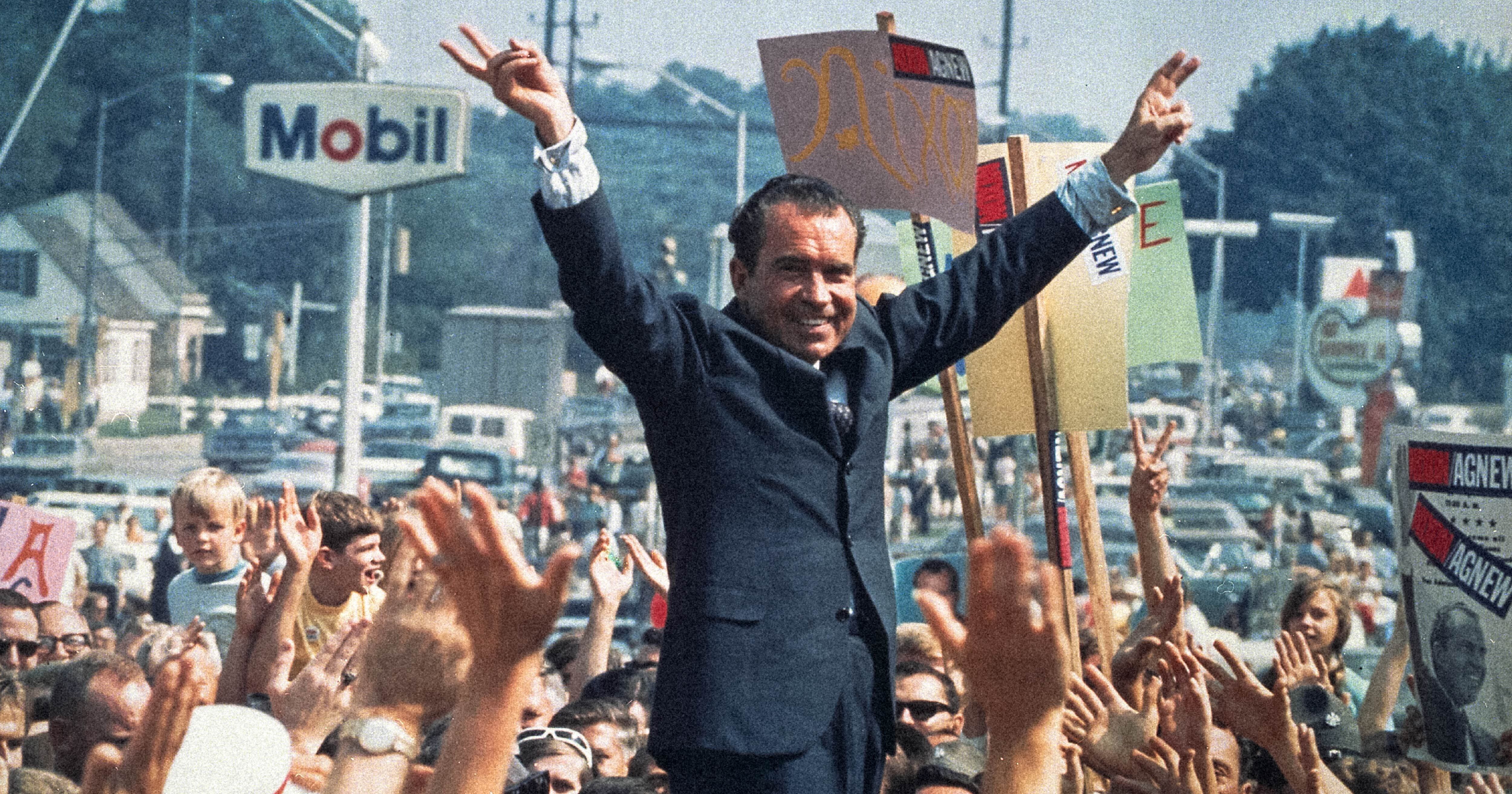
In August 1969, President Richard Nixon called Christopher DeMuth into his office for a new assignment. DeMuth, a recent Harvard graduate, had been working for Daniel Moynihan and had introduced Moynihan to Nixon. The meeting’s ostensible purpose was to begin assembling the 1970 State of the Union address. But Nixon had something else on his mind.
“Chris,” declared Nixon, “I think that in the 1970s, the nature of domestic politics in America is going to change.” American politics, Nixon continued, had been dominated by traditional economic questions, such as bargaining between businesses and labor unions. But Nixon anticipated that quality of life concerns were going to become more important. And Nixon predicted that environmental policy was about to become a major political issue. DeMuth remembered being baffled. “I majored in government at Harvard,” he told me in an interview earlier this month. “I was a pretty sophisticated person. But I didn’t know what he was talking about.”
Nixon’s conversation with DeMuth set in motion the events that led to the creation of the Environmental Protection Agency in 1970. Its creation was bipartisan. Senator Barry Goldwater supported Nixon’s initiative, and that same year, Governor Ronald Reagan signed the California Environmental Quality Act, modeled on federal legislation Nixon had signed. But the honeymoon period didn’t last long. For many conservatives, the creation of the EPA is now one of the blackest of black marks against the Nixon administration. It was an expansion of federal powers that bulldozed limited government, an engine of economically destructive regulations, and an unconstitutional delegation of power.
Conservative criticisms of the EPA are not wrong. But the agency isn’t going anywhere. As in many other areas of policy today, the real challenge is how best to take advantage of a situation in which the structure of the federal government veers wildly from the rails laid down by the Constitution. It’s only possible to pursue sound environmental policy once we understand the shape of our political environment. With this in mind, it’s essential to understand the political circumstances that led to the creation of EPA, and how Nixon perceived it could protect the quality of American life.
The Long Great Society
The EPA emerged from the political conditions set by Nixon’s predecessors. From the early 1960s onwards, the most important change to the American state came from what political scientist Matt Grossmann calls the “long Great Society:” the networks of politicians, policy analysts, academics, foundations, and community organizations that collaborated to expand the scope and responsibilities of the federal government. The most effective politicians leveraged these networks—and were in turn leveraged by them—to pass landmark legislation. Civil rights legislation represents an obvious example, but these networks also collaborated to meet the demands of the burgeoning environmental movement.
In 1962, Rachel Carson published Silent Spring. The book galvanized 14,000 academics and other managerial professionals—the long Great Society’s battalions—to focus on environmental protection. Senator Ed Muskie, dubbed “Mr. Clean,” became the political figurehead. Muskie was a consummate progressive as well as a talented manager of legislative projects. From 1963 to 1969, he shepherded five pieces of environmental legislation through Congress.
These bills helped consolidate a new definition of American federalism. The federal government didn’t need to run all of environmental policy, but it would deputize the states to perform certain tasks, providing federal funds and grants to the states for air control and water treatment programs. Federal enforcement and oversight over environmental questions were exercised across a variety of different departments. The Department of the Interior was responsible for water quality, the FDA for toxic foods, and the Department of Agriculture for pesticides.
Nixon sympathized with many of these initiatives. DeMuth told me that Nixon “had this idea of a moderate, everyday environmentalism. It wasn’t anti-capitalist or anti-growth or a stalking horse for greater government control of the economy. He just thought that air and water pollution had gotten seriously out of hand and become a legitimate, important public issue.” Nixon also brought the concerns of a mid-twentieth century Californian conservationist to the White House. Nixon had grown up appreciating public nature parks, but as a poor Californian, he lamented that there were few public parks available that families of modest means could visit and enjoy.
It also annoyed Nixon that the Johnson administration had enjoyed making grand announcements about opening new federal parks but avoided actually funding them, mainly to preserve the illusion that continuing the Vietnam War and the Great Society were within America’s means. In Nixon, Americans had a moderate environmentalist as president who wanted to fix these and other funding issues—in early working groups, DeMuth noted that the EPA was called the EFA, the “Environmental Financing Agency,” on the basis that its main purpose would be to invest in cleaning up nature.
There was a lot of cleaning up to do. In 1969, 40% of public water systems in the U.S. failed to meet basic health standards. “Most days” in August of 1969 in Washington D.C., DeMuth told me, “the horizon would have been brown, dark brown.” Falling in the Potomac River meant a trip to the hospital because the water was so filthy. One study at the time noted serious air pollution in 212 metropolitan areas with over 50,000 people. Smog events in New York City and elsewhere contributed to excess deaths. The Cuyahoga River Fire in Ohio was one of several flareups in the late 1960s that captured public attention, and in January 1969 came the Santa Barbara oil spill, just after Nixon took office.
Still, DeMuth was right to be surprised by Nixon’s predictions of an imminent environmental movement. A private White House poll from 1969 indicated that only 1% of the public thought that the environment was the most important issue facing the new president. But if that changed—as Nixon anticipated it would—then he would have little say on the future of environmental policy. With progressives firmly in control of Congress, and with the engine of the long Great Society mobilizing congressmen for more environmental regulation, an organized mass movement would force the president to yield to them. Moreover, Congress had granted Nixon a limited time to reorganize Cabinet agencies. Nixon had a narrow window in which to try and reshape the political environment to the advantage of the president, which, if handled well, would ensure that the executive branch could steer environmental policy. The solution, formally sketched out in the Ash Commission, was to embrace the “administrative presidency.” This would centralize the executive branch into agencies that could be run by appointees who were loyal to the president and could be easily supervised by him, and would use existing statutory discretion as the basis for administrative action rather than campaign for further legislation.
Nixon ordered DeMuth to spearhead an interagency task force designed to organize environmental regulations into a single agency. He provided two instructions. The first was to avoid Muskie—he “will go too far,” said Nixon. “He’ll come up with a bill that would close down American industry. I will not do that.” The second was to exclude the Secretary of Commerce, Maurice Stans, from the task force. “If Maury hears what we’re up to, he’s going to have all his businessman pals all over the West Wing here, all over the White House, and we’re never going to get anything done because they’re going to hate what we’re going to come up with,” Nixon warned. But if business lobbyists or the secretary directed their wrath at DeMuth, Nixon would intervene. “He looked me right in the eye,” Demuth recalled, and said “‘Chris, I will protect you.’ Which he did.”
As far as winning the battle of public opinion, the EPA was a success. A few months after Nixon gave DeMuth his marching orders, Nixon’s intuitions were vindicated. Environmentalism blossomed into a mass movement. Activists organized the first Earth Day, scheduled for April 22, 1970; timed to coincide with university spring breaks, it drew 20 million Americans out to demonstrate. This initiative was cheered on across the political spectrum, and Nixon was ready to do his part. Shortly after Earth Day, he announced the creation of the EPA. It was operational by the end of the year.
After Limited Government
The EPA was also an environmental success. It helped bring massive quality of life improvements to Americans. Lead was eliminated from car emissions, as well as sulfur dioxide, which was a key contributor to smog. From 1980-2024, the percentage of sulfur dioxide found in air quality measures has dropped by 95%. Air quality is exponentially better than it was in the 1960s, with demonstrable health benefits.
But as a strategy to contest a political environment defined by progressives, the EPA was a failure. New statutes followed in short succession—the 1970 Clean Air Act, the 1972 Pesticide Control Act, the 1972 Ocean Dumping Act, the 1972 Clean Water Act, and the 1973 Endangered Species Act. These removed much of presidential discretion. Nixon ended up in budgetary battles over how much funding environmental programs should receive, and lost those fights. His veto of the 1972 Clean Water Act failed, and his use of the impoundment authority to withhold funds was eventually struck down as a statutory violation in Train v. City of New York (1975). These were Nixon’s Aspern-Essling and Leipzig before the Waterloo of Watergate. Defeated by his enemies, Nixon’s envisioned administrative presidency never came to fruition.
Moreover, the statutes underwriting EPA authority marked a regulatory revolution that was more significant even than the New Deal. It’s common for conservatives to see the modern administrative state as one long outgrowth from Woodrow Wilson’s brain, but DeMuth makes a convincing case that this overrates the influence of ideas and underrates the effects of legal and institutional changes. What happened in the 1970s was of a different order than what happened in the 1930s. The 5-member New Deal agencies, such as the Securities and Exchange Commission, had narrow regulatory mandates. They operated as limited negotiations of corporate cartels, adjudicating claims, issuing licenses, and handling litigation. The statutes governing the EPA were strong enough to strip presidential funding discretion, especially when coupled with the 1974 Impoundment Act. But Congress delegated much of its own power to legislate to agencies.
So in 1972, it fell not to Congress but to the EPA to decide how to regulate the bane of Silent Spring, DDT. Congressmen didn’t have to be held accountable for the decision. Those who supported the prohibitions on DDT in the United States could cheer on the EPA and secure the applause of environmental activists; those who did not support it could protest, securing applause from agribusiness. The EPA was the capstone of the long Great Society’s political revolution, bringing Congress to its present pitiful state. Congressional activity became theater, as Congressmen preferred to perform for sure rewards from established constituencies rather than enact controversial decisions themselves. In the meantime, the often-arbitrary decisions of administrative agencies are shielded from legislative scrutiny and bad rules get entrenched. The 1970s saw the explosion of new regulations across American life.
It’s for this reason that movement conservatives treat the Environmental Protection Agency as Exhibit A of the catastrophic growth of the administrative state, an engine for economically destructive regulations that defies the precepts of constitutional government. They’re right. Not only is such sweeping delegation at odds with Article I, the EPA’s vast regulatory purview cuts deep into the affairs of the states. It makes a mockery of Article I section I of the constitution and punctures James Madison’s promise that the powers the Constitution delegates to the federal government “are few and defined…exercised principally on external objects” such as war and peace.
But there’s no pathway to abolish the EPA. Nor does the proposal to turn the EPA into a 5-member New Deal-style bipartisan commission—officially in the 2016 Republican platform and intended to slow down a progressive president attempting to control the agency—stand any chance of getting through Congress. Moreover, this proposal harkens back to a vanished political environment. It was the product of a defensive mindset that aims to cordon off the damage the EPA can do rather than to think proactively about sensible environmental policy. Instead of dreaming up structures to limit the EPA’s power that will never pass legislative muster, it’s time to develop fresh strategies to take advantage of the post-2016 political environment.
In the past decade, the Supreme Court has removed key obstacles that stood in the way of the operation of the unitary executive. These changes make it easier to run the administrative presidency that Nixon was denied and to deploy the resources of the EPA effectively. In this new political environment, what would a sensible environmental policy look like?
A Quality-of-Life Agenda
We are living in the end times of the climate change apocalypse. In the 2024 election, only 36% of Democrats ranked climate change as “extremely important,” along with a mere 5% of Republicans. Growing indifference to climate alarmism is even clearer in exit polls from battleground states in 2024, which show that only 2% of voters ranked “climate change and the environment” as the most important issue. As in the White House private polls of 1969, voters do not regard the environment as the most important issue facing the president. While the Democratic Party elites would undoubtedly revert to zeroing out carbon emissions were they to regain power, they won’t campaign on it.
But the waning of climate alarmism should not be mistaken for public indifference to environmental issues. Nixon’s political intuition of 1969 remains correct: voters prioritize the same quality of life issues that resonate with the older conservationist movement. This kind of conservationism—maintaining public parks and natural spaces, expecting visiting foreigners to contribute to this maintenance, protecting farmland, securing hunting and fishing rights integral to maintaining a healthy ecosystem—have become right-coded issues. The MAHA movement’s interest in removing endocrine disruptors in the water supply mirrors the 1960s concern with the effects of DDT on humans.
The present controversy around data centers also shows that the concerns of Americans today align with those of the early environmental movement, not that preoccupied by eliminating CO2. Popular opposition to data centers is often characterized as fear of AI taking jobs. But according to May 2026 polling, most opposition is tied to environmental and quality of life concerns. 50% of people who are opposed to data centers in their area cite its effects on natural resources (such as water) as their main reason for opposition, 22% raise quality-of-life concerns, and another 16% are concerned about pollution. By comparison, 15% cite higher utility bills as the reason for opposition. Other polls (albeit industry-aligned ones) suggest that the opinion on data centers shifts when voters are reassured that those centers recycle water and do not affect clean water supply in the area.
Chris Barnard, the president of the American Conservation Coalition, has proposed letting tech companies build on contaminated Brownfield and Superfund sites in exchange for them cleaning up the land. In July, the Trump administration issued an executive order on data centers, which also directed the EPA to identify Brownfield Sites and Superfund Sites that could be used to build such projects. Those sites would need to be cleaned up, but the tech companies could pay the bill for it. To secure a stable legal environment, Congress would need to follow up on these executive orders by extending Good Samaritan liability protections to companies taking charge of the cleanup. This would ensure they are not sued for pollution they did not create.
The EPA also has the tools to place restrictions on potentially harmful substances and endocrine disruptors in the water, such as atrazine, glyphosate, PFAS, and surplus estrogen. And the agency can also make it easier for local and state authorities to practice sensible forest management. More national and state parks exist since Nixon’s childhood. But massive wildfires—brought about by many state governments effectively outlawing the controlled burns that prevent the buildup of flammable underbrush—have ravaged these parks, rendering many of them unusable each season. One such legislative initiative presently under deliberation in the Senate, the Fix Our Forests Act, makes it easier for the EPA to collaborate with local authorities and approve prescribed burns.
Conservatives should pursue deregulation where appropriate. Removing inept environmental regulations that block reindustrialization should be a priority, as well as those that hinder oil and gas development and nuclear energy development. The Trump administration is exactly right to turn to a hitherto seldom-used provision of the 1970 Clean Air Act. Section 112 grants a facility a two-year exemption from following standards for national security purposes. This should be used extensively in energy and manufacturing, then to reconstruct strategic sectors, such as commercial shipbuilding. And conservatives should take advantage of the rare moments where they control the presidency and both houses of Congress to ban via the Congressional Review Act the zero-emissions standards that Californian progressives have tried to impose on the whole country.
But deregulation isn’t enough. The American public’s spurning of “climate emergency” chatter is a breath of fresh air. It provides a generational opportunity to chart a new course on environmental policy. We can still muse over how to get the structure of the federal government back on its constitutional rails. In the meantime, the train is running on a new track. The structure of the administrative presidency provides the EPA with the tools to enact a conservation agenda that demonstrates how reindustrialization is compatible with protecting natural spaces and human flourishing.

Nixon was even more important for the environment back in the late 60's when he said that we need to be 100% nuclear energy by 2000, or close to saying that. If we were we would not be in all the oil wars and in control of our country much better. They got rid of Nixon, and he wasn't that bad of a president. But the neo-cons didn't like his EPA, knowing to much about Cuba and Fidel, nuclear stance and his wanting to get out of Vietnam which he eventually led us to and championed. But the neo-cons got him booted out. Eventually got their guy put in - Ronnie Reagan.
One problem. Rachel Carson lied about the effect of DDT on humans. You can drink the stuff. She wasn't getting traction with the impact on birds so she falsified research. You want to talk to people who really hate her, try malaria research scientists.