


Scholars, journalists, and commentators are pretty typical conference guests. Babies? Not so much. But there were quite a few babies at The Women’s Convention in Western New York in September—so much so that no one batted an eye when a baby-wearing volunteer, who was passing the mic for a Q&A session, handed off her fussy baby to an audience member (who was none other than prominent theologian Angela Franks) so the session could continue.
The theme of the convention was “a better way forward for women,” with an emphasis on the interdependence of all people—although the aforementioned mothers and babies provided the most legible, and cutest, example. Approximately 200 women (and a handful of men) gathered in a historic mansion just outside downtown Rochester to discuss the Declaration of Interdependence, a document that’s the brainchild of legal scholar Erika Bachiochi. The declaration argues for a way forward that uplifts, not women as an isolated class, but women in conjunction with their families and communities, rejecting the idea that the American economy is a zero-sum gender game.
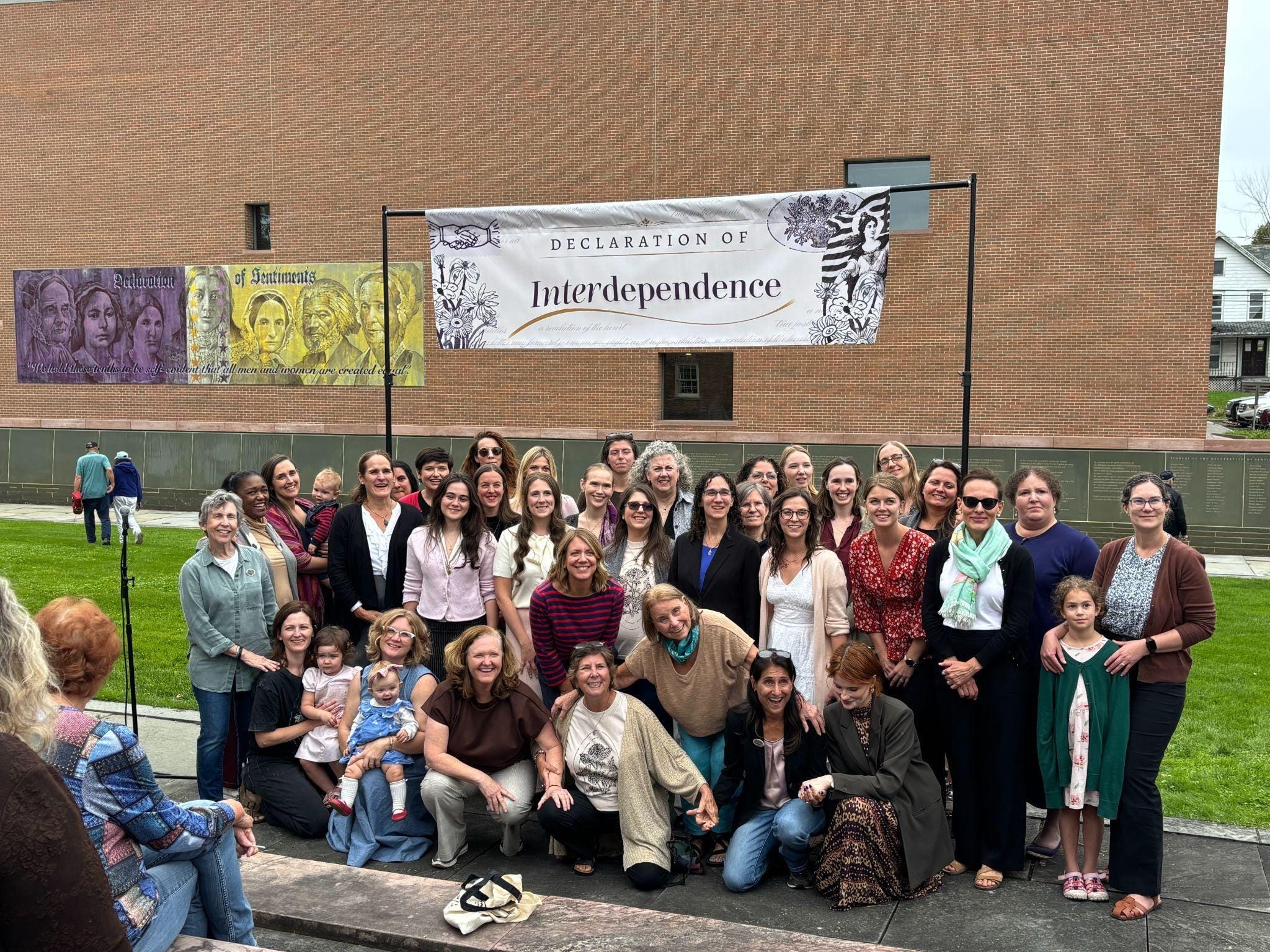
Signers of the Declaration of Interdependence gather for a photo in Seneca Falls, New York, on Sept. 19, 2026. (Photo credit Evie Solheim)
The collaboratively written Declaration of Interdependence contains echoes of its 1776 predecessor as well as the 1848 Declaration of Rights and Sentiments, signed in nearby Seneca Falls, New York. The 2026 convention culminated in a trip to Women’s Rights National Historical Park in Seneca Falls, where women proclaimed the new declaration under a mural depicting signers of the 1848 declaration including Frederick Douglass and Elizabeth Cady Stanton.
“Everyone thinks that having a public voice has to mean a very certain thing—fighting the culture war in very specific ways… I’m not saying that doesn’t have its place, but this felt like something different,” convention attendee Chaney Gooley, who signed the declaration, told me. “It absolutely felt like changing history. I really don’t know how far this will go or how many women it will impact, but regardless, it changed the history of every person there.”
Like the 1848 convention, the present-day one included thinkers of various stripes, from pro-life Democrats to members of conservative media. Some identified as feminists; some did not. What brought an ideologically diverse group of women to Rochester for The Women’s Convention was a sense that “woman in full is not being captured and portrayed, represented, understood, [or] encouraged by our politics today,” Bachiochi, an author who has previously written for Commonplace, told me in an interview.
Nineteenth-century women’s rights activists felt the same. Their abilities to manage their own economic affairs, escape abusive husbands, and seek higher education, not to mention vote, were severely curtailed. Yet in some ways, their times and ours are “mirror images,” Bachiochi told me.
Contemporary discussion of gender roles tends to fixate on the 1960s, when “the pill” enabled the Sexual Revolution and its ripple effects, but many scholars find the early nineteenth century to be a time of similar upheaval. The Industrial Revolution’s effects were more than economic—they rewrote gender relations, changing what was once an interdependent relationship between the sexes to that of independent (man) and dependent (woman), scholars like Bachiochi argue. Today, women have economic independence and are outperforming men on nearly every metric of success, but just like in the early days of the Industrial Revolution, uncertainty looms large. Technology and industry completely changed the concepts of work and home in the nineteenth and early twentieth centuries. Perhaps the same will happen with technological advancements like remote work and artificial intelligence, with either positive or negative effects on family life, in the twenty-first.
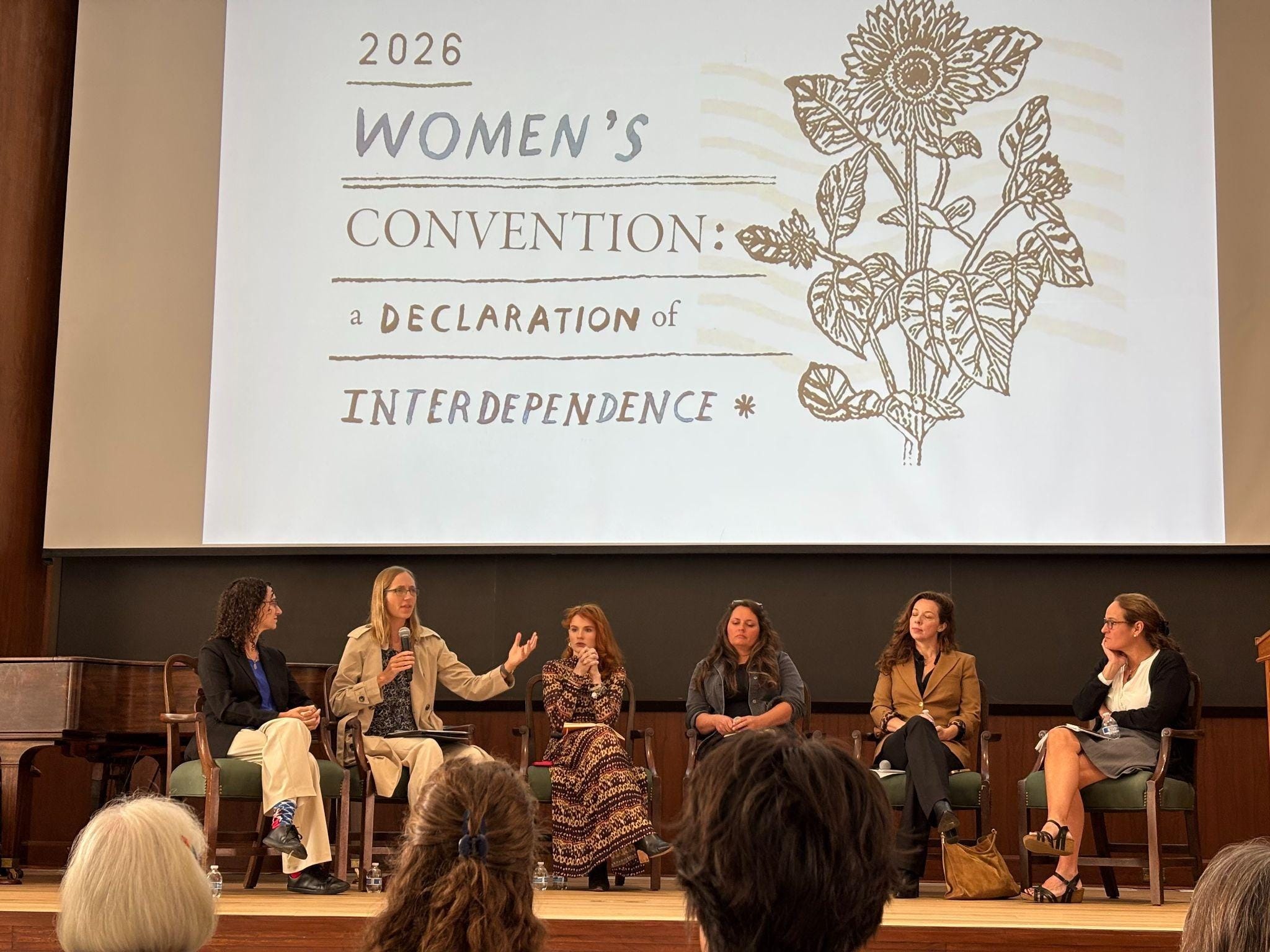
Rachel Lu speaks during the closing panel of The Women’s Convention in Rochester, New York, on Sept. 19, 2026. (Photo credit Evie Solheim)
“A lot of the people associated with the convention are doing the best thinking on this… They want marriage and family to work,” Bachiochi told me. “They just have a lot of realism about it. They are tired of the social media landscape and the gender wars because many of us have men in our lives who we care deeply about, who care deeply about us… The whole landscape is bizarre, and we just need to find something new. It’s like a third space for people who are living in reality.”
Concern About Young Women and Young Men
The Declaration of Interdependence, which is available online and open to digital signatures, decries contemporary emphasis on “radical autonomy” which “has left women and children vulnerable to new forms of exploitation.” The document lists injustices including commercial surrogacy, the sterilization of children in the name of so-called gender-affirming care, and expecting individual women to bear all responsibility for pregnancy and childrearing (that particular section reads “It is unjust… for society to champion those who are unencumbered by familial responsibilities as the standard bearers of equality and civic and economic participation,” an idea familiar to anyone who has read Sargeant’s The Dignity of Dependence: A Feminist Manifesto).
The convention covered a variety of topics, some expected, some not: English philosopher Nina Power spoke about the origins of iconoclasm in the Byzantine Empire; author Mary Eberstadt urged young women to take a Lysistrata approach and refuse to date young men who use pornography; and Paula Belemjian shared a success story from The Margaret Home, a Rochester home for young pregnant women who have nowhere else to go.
Convention attendee Nora Kenney Mittiga told me that she hasn’t decided whether or not to sign the Declaration of Interdependence as she doesn’t want to “define women’s power too narrowly in institutional or political terms.” But she appreciated the ideas and “intentional hospitality” of the convention.
“Bachiochi’s line that women are ‘not made for the machine, for the market, or for men’s desires’ really stood out to me as powerfully emblematic of the conference’s themes—a manifesto of sorts,” Mittiga told me.
Audience members also got the chance to steer the conversation and disagree with speakers and one another (Bachochi found such disagreement “comforting,” she told me). Attendees worried about calls to repeal the 19th Amendment, social media’s tendency to present a caricature of motherhood, and the plight of young men, who are increasingly lonely and underemployed—so much so that the concept of a “stay-at-home boyfriend” is becoming both a meme and Fox News fodder. In fact, some of the questions raised would have fit in just as well at the unrelated Symposium on Young Men, which convened a week later in Washington, D.C. During discussions, women wondered how to help men excel, whether that be by restoring men-only spaces as convention speaker Mary Harrington recommends in her book Feminism Against Progress, or by being effective, capable mothers.
Kristin Collier, a physician and director of the University of Michigan Medical School Program on Health, Spirituality, and Religion, spoke on a panel alongside Harrington about the threat of tech acceleration to women and children. Collier told me that attending the convention was especially important to her as a mother of four sons.
“The flourishing of men depends upon the flourishing of women, just as the flourishing of women depends upon the flourishing of men,” she said. “This is precisely because, as the theme of the convention emphasizes, we are all fundamentally interdependent.”
The Mommy Wars Get Political
The convention was a welcome respite from the mommy wars, such as the national debate early in September over a reported proposal to reform the Child Care and Development Block Grant to allow families with a stay-at-home parent to claim eligibility. On its face, such a proposal sounds quite dry. But the idea kicked off heated intra-conservative debate over the purpose of government, as some pundits rejected the reported proposal as “incentivizing government dependency.” Others, like The Home Front author Ivana Greco, welcomed such a proposal, writing, “We’ve long failed to provide American parents with meaningful choices on one of the most important questions they face: how should they care for their children?”
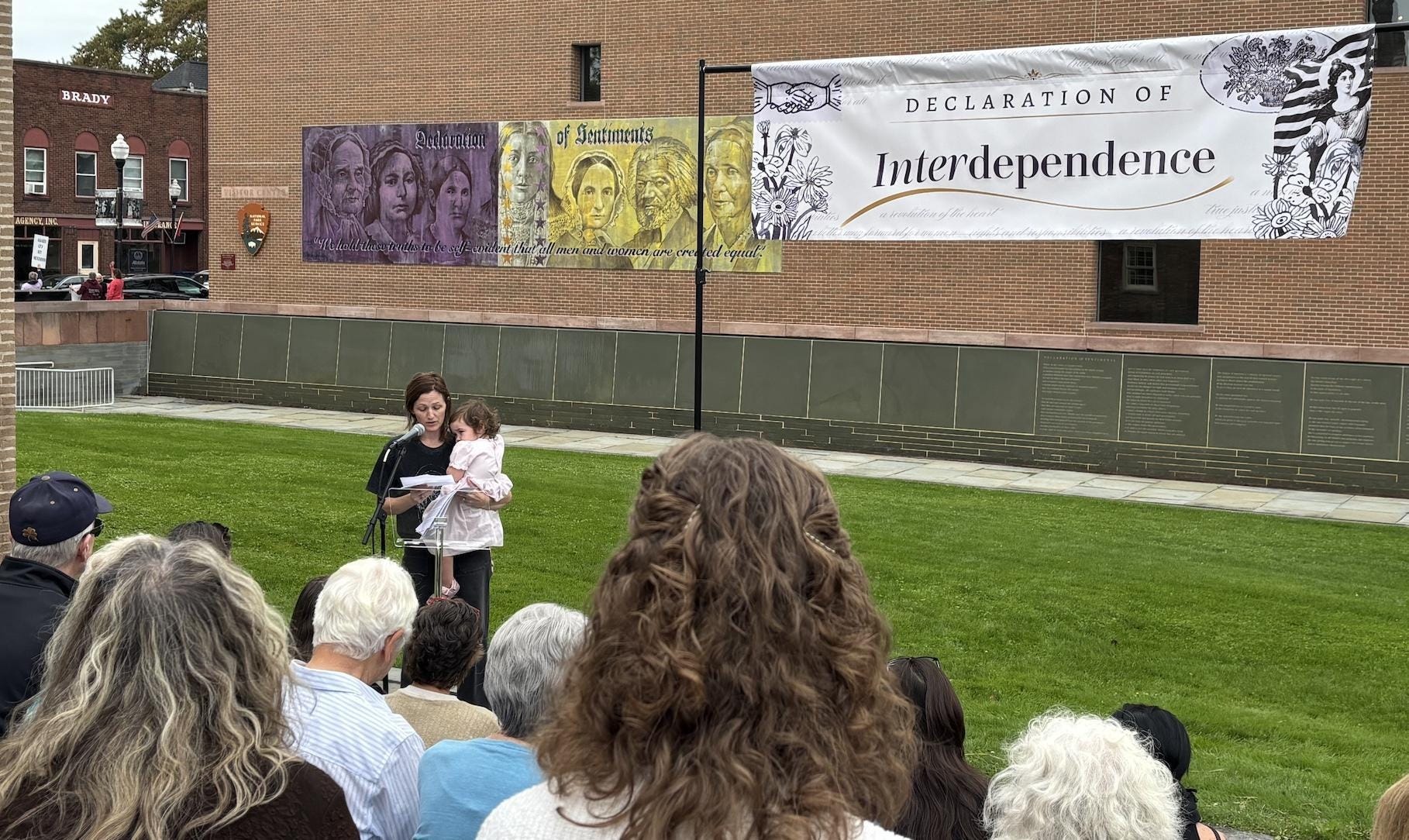
Convention organizer Cecelia Lester reads from the Declaration of Interdependence in Seneca Falls, New York, on Sept. 19, 2026. (Photo credit Evie Solheim)
During a panel on care work at the September convention, Greco observed that better supporting caregivers should be one of the easiest ways to win bipartisan support. She was joined on the panel by The Atlantic contributor Stephanie H. Murray, author Nadya Williams, and political scientist Melody Grubaugh, and they discussed everything from the pitfalls of outsourcing elder care to machines to the importance of postpartum meal trains. One recurring idea was that of the “productive household”—a phrase used by both scholars and patriarchal Calvinists—as one member of the press shared that her home truly feels like a humming economic unit when she’s editing, her husband’s on a Zoom call, her children are with their paid caregiver, and the washing machine’s running.
“I think there was an interest in talking more about creative solutions for care work, moving beyond the more familiar models for child care, in particular,” Williams, who brought her elementary-aged daughter to the convention, told me. “I would have loved to talk about this further, and about the policy hurdles to these things. I remember years ago, the state university where I was working at the time vetoed a proposal for a childcare center on campus, because of insurance concerns.”
The confusion of the transgender movement, the extremes of second- and third-wave feminism, and concerns about misogyny on the Left and Right meant it was time for a gathering like this, Williams told me.
“As the convention showed, there is now a coalition of concerned women that is much broader than anything we’ve seen before,” she said.
A Better Way Forward?
Will there one day be a mural of writers like Harrington, Louise Perry, and Leah Libresco Sargeant who signed the 2026 declaration? Who knows. The convention didn’t produce any white papers, or policy checklists, or new political parties, and like the convention of 1848, the organizers may not see their ideas become reality for many years.
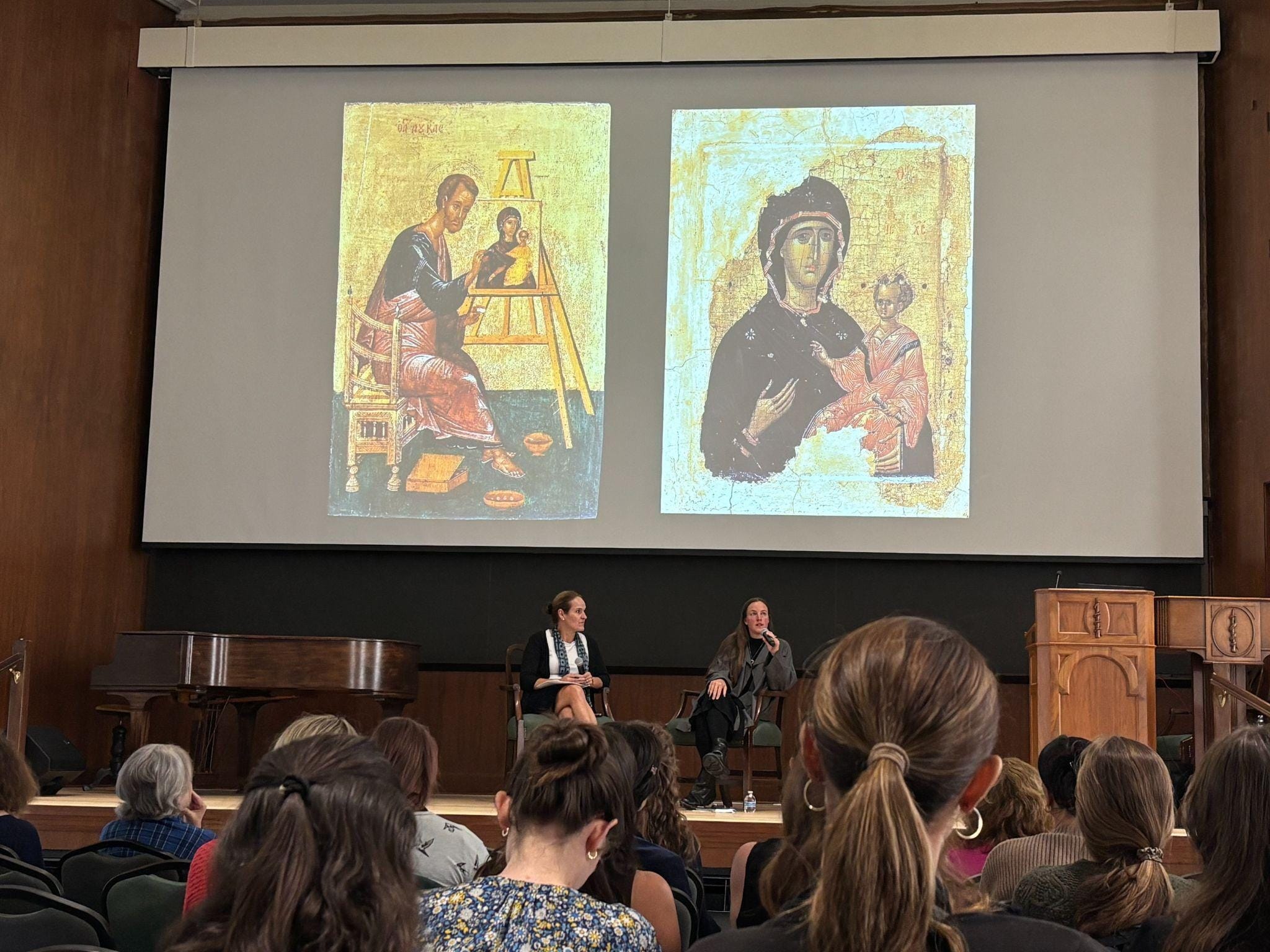
Erika Bachiochi (L) and Nina Power (R) onstage during The Women’s Convention in Rochester, New York, on Sept. 18, 2026. (Photo credit Evie Solheim)
But as researchers estimate that as many as one third of today’s young people may never marry by 2050—some, by choice, and others, by chance—there’s still debate over whether this is a good thing. Women, on the whole, are making rational decisions when it comes to career, marriage, and childbearing, Bachiochi told me. But that doesn’t mean that Bachiochi, a married mother of seven, doesn’t view marriage and family as unique and important goods. As she said in her opening remarks at the convention: “Each girl and boy is born into a family for a reason, and we are meant to rely on our mothers and fathers and sisters and brothers and aunts and uncles and teachers and mentors and myriad others to care for and guide us and form us so we might become the kinds of people capable, one day, of doing the same for our own. And women, of course, have always been at the center of this culturally essential formative work.”
That formative work is hard to define economically, but that doesn’t mean conservatives shouldn’t consider it deeply. Greco’s earlier observation that supporting caregivers has broad appeal has real political implications. Instead of writing off young female voters, the Right can listen to what they want—which, sometimes, is as simple as paid parental leave. If today’s conservatives can figure out how to help men and women work together, instead of war, they may have a real winning coalition on their hands.
