


Canadians are in a state of high excitement over Prime Minister Mark Carney’s decision to blow up trade negotiations with the United States and pursue a deepened trade relationship with the European Union. Carney’s move is being cast in world-historical terms as his approval ratings break 60%. Clearly, there is a sense of national consciousness awakening as a country that had long settled into a comfortable routine discovers a grand purpose.
Carney himself appears to agree, reaching for analogies to the most decisive conflicts in Western history to describe the stakes of the present moment. In a speech last week before the European Parliament, Carney invoked Buchenwald, the World Wars, and the most portentous dates of the post-war order: “Freedom and life must be earned every single day. Every day. Not once in 1945, or 1956, or 1989. Every day, including this one.” Carney’s peroration concerned the Battle of Vimy Ridge, a deadly World War 1 battle in France that saw heavy Canadian casualties:
It is often said that Canada became a nation during the battle of Vimy Ridge. Certainly, the thousands of Canadians who did not return from that battle sacrificed their lives for something much bigger than themselves…Today, the same Vimy oaks grow in Canada and in France, living proof that what we cultivate together can survive the darkest winter to thrive again. So, let us now deepen these roots, widen this canopy, and grow a transatlantic forest under which our citizens can flourish as free people on free ground.
The problem is that, in real terms, this is about a 15% auto tariff. Canada, in pursuit of the psychic satisfaction of conflict, purpose, and national solidarity, risks misreading the situation and needlessly destroying its trade relationship with the United States in exchange for a dead-end relationship with Europe—and possibly a more predatory one with China. That will make Canada weaker and poorer, which may end up threatening its sovereignty more than any of President Donald Trump’s policies.
It will also threaten the United States. Canada is frequently our top trading partner, and a poorer Canada means less opportunity for the American economy. Moreover, an economically strained Canada on the hunt for commercial partners is more likely to double down on attracting Chinese capital and industrial investment, risking the integrity of the North American market. Canada occupies a unique position in the American industrial base, consuming over $150 billion of American manufactured goods every year and providing important inputs to American production, including 4 million barrels per day of heavy crude for American refineries, potash for fertilizer, and critical minerals. If China enters that system, the result could be the worst of all worlds: a weaker Canadian economy and a less secure American industrial base.
Manufacturing Crisis
When Carney’s government decided to break off trade negotiations with the United States in August, the sticking point was prosaic. The United States currently imposes a 25% “sector-wide” tariff on global auto imports, but Japan and Korea have a preferential 15% rate following negotiations with the Trump administration. Canada, not wanting its exports to be disadvantaged, sought its own reduction to 15%. We appeared willing to make the concession.
The trouble began when Canada demanded that the reduction also include medium and heavy trucks, such as the pickups Ford manufactures in Ontario. The United States resisted because medium and heavy trucks fall under a separate truck tariff, not the auto tariff under negotiation. At that point, the Canadians hung up the phone. “You’re at war when you get attacked. We got attacked,” Carney explained afterward.
Indeed, Canada understands itself as the target of a trade war that President Trump unilaterally declared on an unsuspecting and friendly nation, a war that weaponizes Canadian economic dependence on the United States and threatens Canadian sovereignty. The details of exactly what tariffs were imposed and when can seem cloudy to many, but what feels certain is that the Trump administration imposed them while talking about Canada becoming the “51st state.” That rhetoric cuts through and shapes Canadians’ interpretation of the technical details. Any nation would be expected to respond with hostility to such talk.
But national feeling aside, the technical details matter. In this case, they establish that Canada wasn’t truly targeted and that the situation on the ground differed sharply from what Trump’s rhetoric suggested. Yes, one of the first trade actions of the second Trump administration in February 2025 was to use the IEEPA statute (rest in peace) to impose 25% tariffs on Canadian imports. But the administration also included Mexico and China in the order, exempted imports from Canada covered by the USMCA free trade agreement, and then, one month later, imposed equivalent or higher tariffs on the rest of the world on Liberation Day.
Canada wasn’t uniquely targeted. Rather, Canada was included in a broad policy to rebalance the United States’s trade relationship with the entire world. This rebalancing uses tariffs to reduce America’s import dependence and reshore strategic industries following decades of unsustainable deindustrialization. Of course, such a rebalancing falls heavily on Canada, which sends 70% of its exports to the United States. But Trump’s Liberation Day tariffs again exempted Canadian (and Mexican) imports under USMCA, which gave Canada a massive trade advantage relative to other countries. When the dust settled, Canada found itself with a scarce and valuable asset: tariff-free access to the massive U.S. market.
At that point, Canada could have joined other major world economies, including its USMCA partner Mexico, and negotiated for tariff reductions. Instead, Canada retaliated against U.S. auto tariffs, which are imposed on a global basis for national security purposes under Section 232 of the Trade Expansion Act of 1962. Such national security tariffs are imposed without a USMCA exemption. Canada believed that this constituted a violation of the agreement, but rather than settle the dispute through consultation, it became the only country besides China to retaliate against trade measures that were in fact applicable to the entire world.
In April 2025, Canada retaliated by implementing a tariff regime applicable only to American vehicles—and then punished American manufacturers that transferred production out of Canada to the United States by reducing their tariff-free export quotas. According to the White House, American auto exports to Canada fell by 22% following Canada’s new policy. After months of fruitless talks, in July 2026 the United States responded by announcing 50% tariffs on $20 billion of Canadian imports with no USMCA exemption. Canada retaliated again with equivalent tariffs, and it was the negotiation to end this standoff that broke down.
When Carney blew up the talks, he announced gravely that the proposed deal had threatened Canada’s sovereignty, citing U.S. efforts to “restrict our ability to have other trade deals.” Carney’s government has refused to say more about the restriction in question, but it likely concerned Canada’s deepening “strategic partnership” with China, under which Chinese EVs enjoy preferential duty rates and Chinese EV makers are exploring joint ventures in Canada that would enable them to access the North American market. While Carney was tight-lipped, U.S. Trade Representative Jamieson Greer did the media rounds and explained clearly that the United States can’t be expected to sign a free trade agreement with Canada if Canada allows itself to become an export platform for heavily subsidized, non-market economies like China.
That’s not a restriction on Canada’s sovereignty. Canada has no entitlement to freely trade in the United States’s internal market, the control of which is a core pillar of American sovereignty. If the United States attaches conditions to that trade—such as a rule prohibiting Canada from passing its U.S. market access on to China—Canada is free to weigh the costs and benefits, just like all of the sovereign countries that concluded such conditions were well worth it.
Conditioning Canada’s preferential market access on limiting trade with China, or denying an auto tariff reduction to pickup trucks, does not merit analogies to the World Wars. Even with the Trump administration’s sectoral tariffs, the average U.S. tariff on Canadian imports is 5%—not quite the invasion of France. Yet Canadian media has decided to emphasize Trump’s rhetoric over his actual policies, comparing Carney to Winston Churchill and earnestly asking whether Trump plans to invade Canada (the bewildered American admiral’s response: “Would you ask me, please, also, what my attack plans are for the Martians?”). Carney’s popularity has surged as he single-handedly turns this perplexing trade dispute into a crisis and manufactures a grand trial for Canadian nationhood.
It seems that the real driver of these events is the psychic need for such a trial. Canada hasn’t had one in a long time, and prosperous liberal societies aren’t very good at generating them even as we crave thymos, the Greek term for the spiritedness that comes from struggle and purpose. Listening to a recent Francis Fukuyama interview about how liberal societies might generate thymos, one can’t help think of Carney:
Well, there are some possible futures where [liberal societies] actually do face real threats, where the society really does have to mobilize. I think we felt something like that in the 1930s with the Depression and then fighting World War II, and that was very inspiring to many people. It was also very devastating. And the question is, can you recreate that sense of national purpose without having a war or pandemic or revolution? I think you can. I think that there are a lot of projects out there in the world that could be the source of a greater sense of common purpose.
In his 2021 book Values, Carney identified such a project: fighting climate change. Now, Carney appears to have found a new, more politically potent project: reorienting Canada away from the United States and realigning toward the EU, which may or may not be willing to offer Canada “associate member” status. There is no template for what such status might entail, and any benefits and obligations would ultimately be up to member states to determine. The question is whether this realignment will make Canada stronger, or whether it will instead generate “devastation.” Returning to the trade fundamentals, the smart money should bet on the latter.
Blood from a European Stone
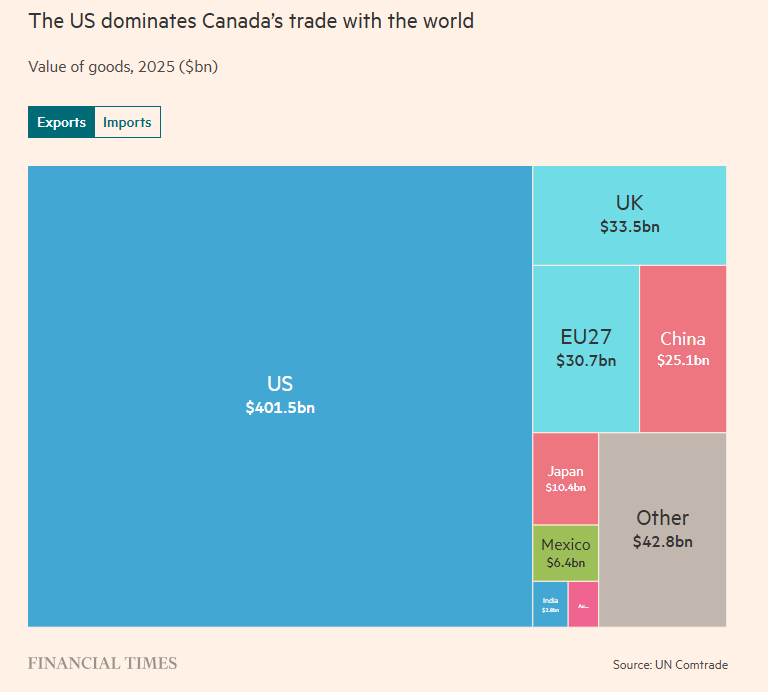
Last year, Canada exported about $400 billion worth of goods to the United States, responsible for nearly 16% of total Canadian GDP and for 41% of all Canadian manufacturing jobs, including over 75% of auto jobs. Conversely, Canada sends about $40 billion of goods to the EU. For Carney’s strategy to work, there needs to be demand in the EU to replace any reduction in goods that Canada sells to the US. But the project of redirecting Canada’s exports away from the United States and toward the EU looks like a project to make water run uphill.
The most popular policy for creating demand, a free trade agreement, was already implemented in 2016. CETA, the Canada-EU free trade agreement, hasn’t been ratified by all EU member states but its key terms are already in force on a provisional basis. That means that the vast majority of goods trade between Canada and the EU already takes place on a zero-tariff basis. No new demand to unlock there.
Another powerful determinant of trade between countries is regulatory alignment. Things like food and auto safety rules, product standards, labeling requirements, drug licensing, and so on have a decisive impact on market access because countries can choose whether to accept their trading partners’ regulatory standards as equivalent or else demand compliance with their own standards.
Canada has very tight regulatory alignment with the United States, the product of decades of trade negotiations and supply-chain integration. The EU, meanwhile, remains an exceptionally jealous guardian of its regulatory standards. The bloc requires non-members, such as Norway and Switzerland, to adopt EU regulations and pay into the EU budget as a condition of accessing its large single market. The EU has no incentive to allow Canada to enjoy the benefits of the EU market without these obligations, because member states would likely demand similar treatment and fracture the bloc. After Carney’s speech at the EU Parliament, EU Trade Commissioner Maroš Šefčovič cautioned that “there would be no special treatment for Ottawa.”
Even if it could be achieved, the project of Canada-EU regulatory alignment would be a curious way to safeguard Canada’s sovereignty. The essence of the European project is the delegation of national authority to a transnational bureaucracy in Brussels for the sake of economic integration. Further, the project is zero-sum. Canada is already embedded in a North American regulatory system under USMCA, which contains extensive disciplines on technical standards, sanitary and phytosanitary measures, testing, certification, and regulatory cooperation. Achieving regulatory alignment with Europe means ditching these USMCA commitments, creating costly new barriers to trade with the United States.
Is it worth it? The U.S. market generates about $10 trillion more demand than the EU and significantly more annual growth. The EU regulatory undertaking has proven itself to be a Procrustean bed of declining productivity, weak innovation, crippling energy costs, and political sclerosis—problems with which Canada is all too familiar. It’s hard to imagine any scenario where adopting the European rulebook nets Canada out ahead. As Ambassador Greer noted, zero growth plus zero growth still equals zero growth.
At the sector level, the EU is structurally unable to provide replacement demand for the industries Canada most needs to redirect. Canada is a powerful exporter of energy, agricultural products, and manufactured goods. But Canada’s energy industry is built to export to the United States via pipelines and currently sends more than 90% of its exports there. The infrastructure necessary to export energy to the EU would take years to build. Canada’s first long-term LNG deal with a European buyer, announced this year, isn’t expected to begin deliveries until the early 2030s. Unfortunately for Canada, the Trudeau government declined to support new LNG terminals that might have proved valuable today. There are even rumblings that Canada would have to bring itself into alignment with the EU’s greenhouse gas emissions monitoring system in order to sell energy in their market.
Meanwhile, the EU’s agricultural market is notoriously protected, and prying it open may be impossible even if CETA were ratified. Current Canadian ag exports to the EU are tiny, and the last thing that European member states want is protesting farmers clogging roadways with their tractors when imported Canadian grain and beef arrive.
Nor is there much complementarity in manufactured goods. Canada produces autos, steel, aluminum, chemicals, and machinery, but Europe already produces these goods in abundance. Rather than serve as a customer for Canadian industry, the EU is a competing producer defending its own industrial base. European manufacturers have little interest in exposing themselves to another source of import competition as they struggle with weak domestic demand, high energy costs, and a rapidly growing wave of Chinese exports.
Indeed, nothing Canada and the EU do together amounts to much if both markets remain open to China. Each year, China doubles down on a strategy to achieve growth by dumping massive volumes of subsidized industrial exports onto world markets, wiping out competitors. China is steadily deindustrializing Europe, but despite a record number of strong statements, the EU has been unable to agree on measures to defend its market. For its part, Canada has chosen to see China as an opportunity to triangulate against U.S. influence and has opened its market to Chinese EVs. If the EU and Canada are unwilling to exclude Chinese overcapacity, integrating their markets will not restore their competitiveness. It will simply create a larger market for Chinese producers to conquer.
You’re Not Sovereign If You’re Desperate
The fundamental flaw in Carney’s strategy is that he is trying to attract capital and forge new trade relationships while degrading the value of Canada’s most important geoeconomic asset: duty-free access to the U.S. market. Why invest in and trade with Canada if it might replace USMCA with uncertain European commitments and lose its privileged position in the much larger North American market?
As Ambassador Greer pointed out, that isn’t our problem: The United States has no interest in so-called free riding by non-parties to the North American trade agreement. But there are real risks. A capital-starved Canada may start selling off assets to China. Indeed, at a recent investment summit, representatives of the China Investment Corporation, China International Capital Corporation, and the Hong Kong Monetary Authority scouted opportunities to invest in pipelines, ports, power infrastructure, LNG, and other highly sensitive projects. Former Canadian diplomat Michael Kovrig noted that “Canada is a test. If PRC capital can become ‘acceptable’ again inside America’s closest ally, the precedent matters for the whole West. The objective may be re-establishing that ‘Chinese money is normal money’ in a G7 country.”
Canada’s seeming appetite to climb into the European regulatory straitjacket and sell out its critical infrastructure to China puts an ironic spin on the sovereignty question. A Canada deprived of the market for 70% of its exports will be weaker, poorer, and desperate for new commercial relationships. It will be bargaining with Europe and China from a place of weakness and will become a price-taker on growth-strangling EU regulations and on geopolitically predatory Chinese capital. Canada thinks it’s safeguarding its independence, but it will more likely find itself receiving new terms from new masters. The difference is that the new terms won’t make any economic sense.
Carney’s best move is to see if Trump wants to get a deal in the headlines before the U.S. midterms and then come back to the negotiating table. Carney has established his political credibility, so averting industrial armageddon with the country behind him looks like the best of all worlds. But the Trump administration will retain significant tariff authorities even if Republicans lose their majorities in Congress, and it may well conclude it need not abet Canada’s nation-building quest. Why should we be in a free trade agreement with a country that is itself in a “strategic partnership” with China? Why shouldn’t we welcome the four-in-ten Canadian manufacturers who say they’re considering or have already moved production to the United States due to trade uncertainty? Why should we reward the Carney government for manufacturing a crisis that didn’t exist for the sake of sovereignty that was never truly under threat?
In the end, Canada may have only thymos to gain. As Brexit showed, the voting public can decide that perceived self-ownership is well worth shaving a few points off GDP. But as Brexit also showed, self-ownership doesn’t really feel like it when you remain at the mercy of larger markets and find yourself getting poorer all the while. It feels more like doing a lot of begging, which is the opposite of sovereignty. Canada will likely end up deciding that it’s worth it to take a tariff haircut from the Trump administration, restrict Chinese investment, and continue to trade with its rich neighbor. That would certainly be in the American interest.
The alternative is that Canada keeps going. It sacrifices privileged access to the U.S. market in order to prove that it can live without it, discovering along the way that Europe cannot replace the demand, China is purely extractive, and that policy has a hard time overcoming economic geography. At that point the economic crisis Carney manufactured will have become real. Canada will finally have the great national trial it was looking for—only the threat to its sovereignty may no longer be rhetorical.

"Canada blew up negotiations" ???? Canada had a deal USMCA and the Donald reneged on it. It was his deal from 2018; can't blame Biden or Obama or the bankers or Taylor Swift. Sad thing is now Canada can't just wait for 2028 and trust us in future that we don't elect another clown like his orangeness. They have to make their best deal; smart move to pivot to Europe.
Carny and Canadians are showing their female behavior that burns the house down in resentment and rage and blames real men for the resulting sad outcomes.