


The fall was great, because the town was great.
Michael Morris, who was born here and stayed, is driving my husband David and I around a barren area that used to be the working-class neighborhoods of Springfield, Ohio. He describes a thriving place where people could walk to work and to church, leave their doors unlocked because they knew their neighbors, get a drink with friends at the bar on the corner. “They didn’t live elaborately,” he says, “but they took care of things.” The rows of mansions on a nearby street indicate a socioeconomic integration that drove investment in a shared physical place.
Now, there are dilapidated houses, boarded-up windows, grime. The remains of bygone industry—piles of broken concrete, sagging buildings among weeds—run parallel to the railroad track in long stretches. As Michael points and narrates, there’s something about it that feels a bit like a crime scene investigation: what happened?
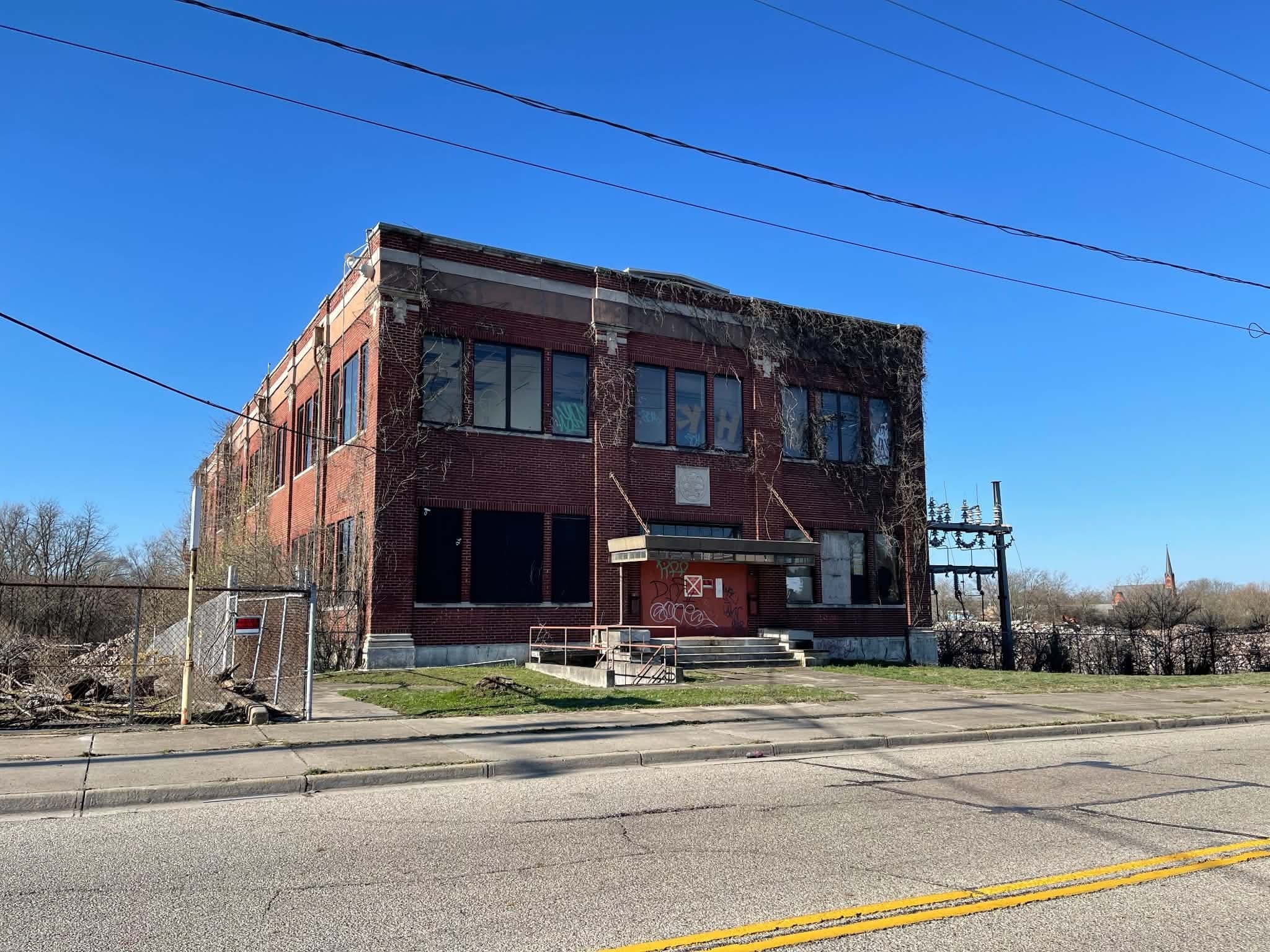
Former headquarters of White Motor Company, Springfield, Ohio. Photo credit: Michael Morris, Springfield resident.
The town became the center of attention during the 2024 election, and while President Trump’s claims about pet eating were named Politifact’s “Lie of the Year,” vociferous city commission meetings suggested that residents on both sides had more to say about the estimated 10,000 to 15,000 Haitian migrants who had come to Springfield since 2020 under Temporary Protected Status.
Trump won Clark County, which includes Springfield, with 63.9% of the vote, the best performance for any Republican presidential candidate in the county since 1928. Things were closer in the city itself, but Trump narrowly won Springfield after having lost it four years earlier to President Biden. After taking office, the Trump administration ended TPS for Haitians last summer, and Immigration and Customs Enforcement, better known by its acronym ICE, began activity in the area in August.
Initially drawn to Springfield because of this story, after talking with a dozen residents and people with connections to the area, I came to see a larger story, one that began decades earlier.
Downtown, I’m surprised by the grandeur of the buildings, like the magnificent Old City Hall which is now the Heritage Center of Clark County. Springfield feels like a larger city than it is, a tribute to the way that former prosperity built up the place and created impressive institutions. A “Wall of Remembrance” inside the museum includes rows of twentieth-century businessmen and philanthropists, a good number of whom went off to Harvard, Princeton, or Yale, and then came back to found insurance companies, become president of the Springfield Rotary Club, or serve as a trustee of the Springfield Symphony Orchestra.
“[There is a] train of talent that either is from here or comes through town,” marvels Michael, who founded the Center City Association in 1998 and ran for mayor in 2003. We are standing in a downtown office building looking at a series of banners displaying famous people from Springfield: musicians like Johnny Lytle and John Legend, actors, statesmen, Ohio governors Asa Bushnell and the incumbent Mike DeWine, athletes and coaches, the founder of 4-H, the children’s author Lois Lenski, and the Wright brothers’ patent attorney.
“The Wright brothers can seek out patent attorneys anywhere they want to, right?” Michael asks. “And they come to Springfield, Ohio and work with Harry Toulmin! We were great.”
In 1983, Newsweek devoted an entire 160-page issue to the story of Springfield, Ohio, after a two-year process to identify a place that could best represent the “typical American city.” In his introduction to the issue, editor-in-chief William Broyles Jr. wrote of Springfield: “It is its own place, different from every other. But at another level it is every American town, and the people who come to life in this narrative are connected by circumstance and character to all of us.”
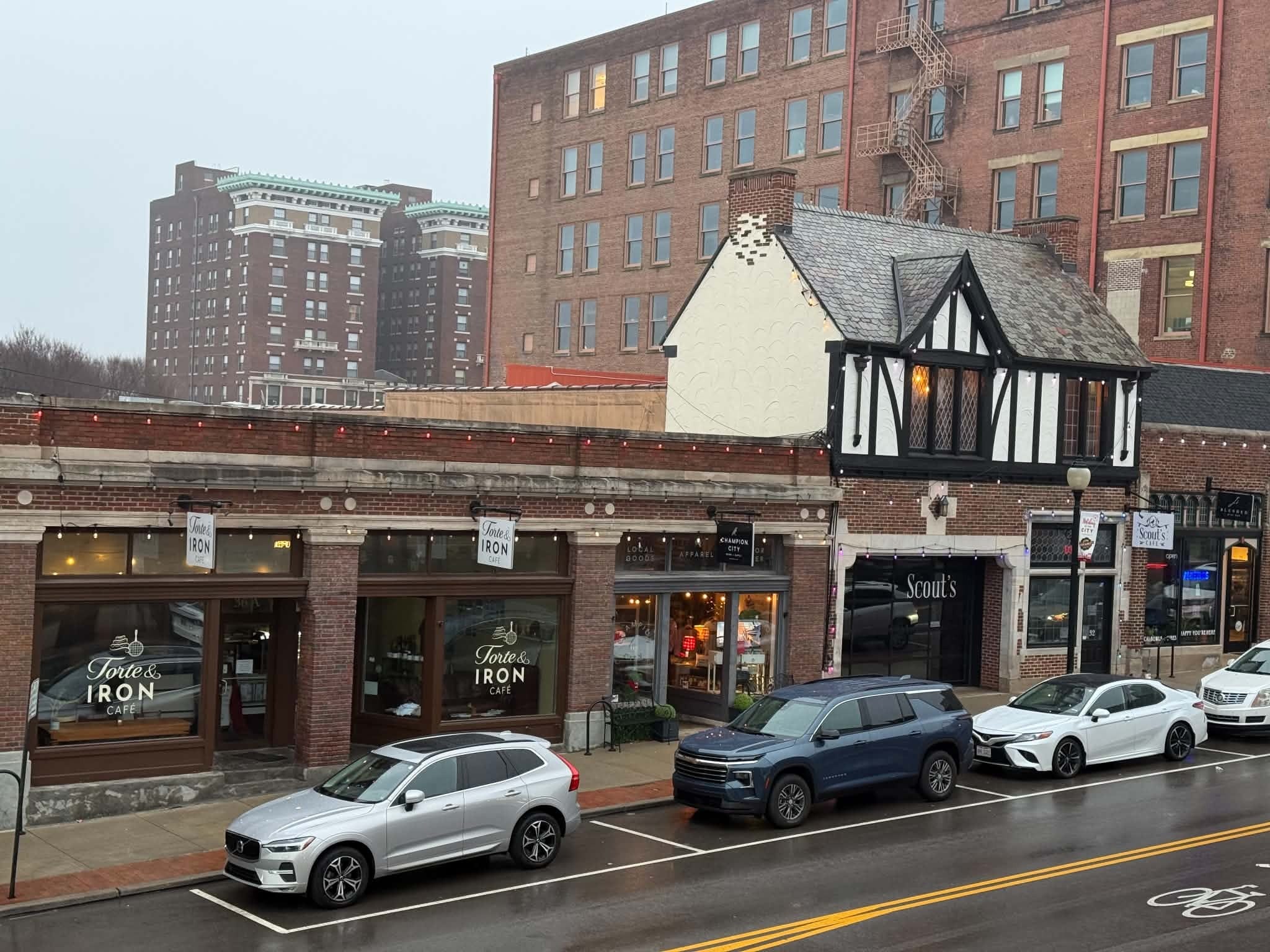
Downtown Springfield, Ohio. Photo credit: Michael Morris, Springfield resident.
But even then, the story of Springfield was beginning to shift from “dream city” to one with an at-risk middle class. A recession and notable conflict between labor and management at a big local employer were early warning signs, among other large-scale changes in international trade and technology.
Out the car window, more rubble of former industry flashes by. Suddenly Michael pulls over. He’s got to show us a video that he says was prophetic. It’s presidential candidate Ross Perot’s 1992 warning about a “giant sucking sound” if the North American Free Trade Agreement was ratified. Two years later, it took effect, and NAFTA hit the city hard.
Between 1999 and 2014, median household incomes in Springfield dropped by 27%, from $73,895 in 1999 to $53,957 in 2014, with the city losing more share of its middle class than any other metropolitan area in the country.
Springfield, then, is poster city for the rise and fall of the middle class as well as icon of another American story—immigration. The two plots are more closely connected than is commonly told.
“The problem is that they came when we were at a weak spot,” lifelong Springfield resident Terry Adkins tells me over breakfast with his wife Mary at the IHOP on North Bechtle Avenue, referring to the Haitian migrants.
“I don’t care if they’re purple, yellow, or from Mars,” Mary says. “That’s a whole lot of people to put in a small area in a short period of time without making infrastructure changes, without making changes needed to sustain that.” Springfield, a city of 58,000 whose population had been steadily declining over the last half-century, suddenly grew significantly. Mary worried that Haitian migrants weren’t assimilating well and didn’t want to become Americans.
Terry, a member of Concerned Veterans for America, sports an “America 250” ball cap and a black “We the People 1776” T-shirt, with a skull whose face fades into an unfurled flag. Mary is draped in stars and stripes. Mary and Terry remember a time when Springfield was the setting of the proverbial high-trust, midcentury childhood: unsupervised bike rides until dinner time, shopping at local stores within walking distance, nobody locking their doors.
As they grew into adulthood, Mary and Terry watched their hometown decline. Buildings were abandoned, including a dilapidated Frank Lloyd Wright house that had been carved up into apartments. Drugs became a problem in the 1980s and 1990s. “When I was a kid you never heard of that,” Mary recalls, mentioning that today Springfield sits along a drug trafficking corridor.
There are still jobs available in Springfield, Terry says, but they were different from the unionized jobs of the past: “Many of them are not paying a living wage. And that’s part of the problem.”
A 2016 NPR story described a similar reality. Springfield had jobs, but not many that would earn a middle-class living.
Andrew, a 39-year-old lifelong Springfield resident, tells me that it has never been difficult to find a job. Even in high school he worked two jobs, and most recently he was employed in food service. But he observes that the nature of work has changed.
“You got to put them years in taking the low bottom of the totem pole to work your way up,” Andrew tells me. “But those type of opportunities are rare anymore. It’s like they’re out the window for everyday people, man. There used to be a lot more of it, and I don’t see that as much now. You got people willing to take whatever comes their way to barely live paycheck to paycheck.”
Andrew notes that one driver of this trend is the rise of the temp agency.
“The temp thing was new in the day, the last decade or two, because it was more cost effective,” Andrew says, describing a landscape in which the kind of jobs that high school kids used to do are now taken by adults. “Now it’s full-grown adults trying to raise a family, trying to take those jobs because there is nothing else—or their only opportunity is to temp, and they’re not guaranteed.”
Andrew contrasts this with “the real serious jobs, the good paying, the let’s-build-a-career job like Navistar was for this community back in the day.” Now the more common path is to use a temp agency. “It’s not secure. It’s not guaranteed,” he says. “You might get a full-time spot… and even then, [the employer] might just up and dip and go to another country, you know? Clinton allowed that back in the 1990s.”
The spillover effects of a low-wage economy are difficult to overstate. Springfield residents told me about a loss of dignity and self-confidence, family squabbles, the erosion of civic life and church attendance, and addiction. Even when people land a good opportunity they can struggle with lingering addiction or anger issues. I heard about administering Narcan to a factory worker who overdosed on the line.
Michael Morris, who emphasized that a lot of problems are downstream from the loss of good jobs, also speculates that maybe part of what happened is that the workforce got “kicked in the shins” so often that it lost some of its resilience. “In my mind’s eye, what happened was we had a town that wasn’t showing up for the employers.” He describes the shift from “Champion City,” an old nickname of Springfield, to a “Woe Is Me City.” He wonders if this created some of the demand for employers to look elsewhere.
Terry says that immigrants coming to Springfield for jobs put even more downward pressure on wages. He mentions a friend who worked in manufacturing making $21 an hour before he was let go. Now he says the same factory is staffing its workforce with Haitian migrants who are brought in through employment services created to help refugees learn skills and find jobs, but that these workers are generally willing to accept lower hourly wages with fewer benefits, allowing companies to hire more workers at a lower cost.
A recent piece in The Guardian seems to describe a similar trend, arguing that one of the benefits of Haitian migrants in Springfield has been “cheap, reliable labor” and that since TPS ended (prompting many Haitians to leave) “businesses, big and small, are struggling.”
“The Haitians are being exploited,” Mary says. “We feel bad for them being exploited.”
Mary remembers a time when Springfield workers were earning a middle-class living. She had family members who worked for International Harvester, which had a massive plant in Springfield that made trucks for much of the twentieth century and agricultural equipment dating even further back. Terry spent years delivering the trucks they produced.
“International was a big thing in town,” Mary notes—and so were the United Auto Workers, with Local 402’s building located just down the street from the plant. According to Mary, the company began declining in the early 1980s following a lengthy strike, which commenced after the then-new CEO wanted to initiate mandatory overtime and change seniority rules. In 1986 the company became Navistar, and it began moving operations to Mexico in the mid-1990s and to Texas in 2020. But even after all those moves, there were still almost 1,400 people working at the plant in Springfield.
That is until a couple weeks ago, when the last truck went down the line.
“It’s sad,” pastor Barron Seelig says as he hands me a tray of loaded nachos from the window of his food truck parked outside of the International Harvest Scout, Truck, and Tractor museum where a vintage truck show is happening. “But they say it’s progress.” He shrugs, and then adds with a mischievous gleam in his eye, “If the opposite of pro is con, is the opposite of progress, Congress?”
The food truck funds Barron’s homeless ministry, and the tagline is, “Eat here or you and me both starve.” Even as Springfield has grown in population and attracted new business, including a Canadian company, Roshel, that will be moving into the former Navistar facilities, housing costs have risen alongside homelessness.
Yet in March, the city’s only dedicated shelter provider shut down after declaring bankruptcy.
Barron doesn’t blame the Haitian people—“they’re as much victims as anyone else”—but also thinks it has been a challenge for a city already short on resources to absorb more people. His friends say he’s MAGA, but he doesn’t see himself as political. He sees both sides spinning their narratives, “making a circus of it,” and not enough people doing the work of helping one another get back on their feet. “Who wouldn’t want to make America great?” Barron asks.
His latest project, NICE Agents, which stands for Neighbors Investing in Community Empowerment, is his effort to turn the public conversation about Springfield into practical neighborly action.
There have been many signs in Springfield over the last few years: signs like those held at the prayer service I attended in February with clergy and citizens praying for an extension of TPS; the sign of the homeless man who was the first person I saw when I pulled off the exit and into Springfield; the sign at the Navistar plant covered over with a large piece of material to signify its closing. People were gathering in solidarity in response to the migrant crisis, but what about in response to the news about the homeless shelter or the factory closing? It reminds me of a post I saw a Springfield resident make on Facebook: “Where are the people holding up signs for their own friends and neighbors?”
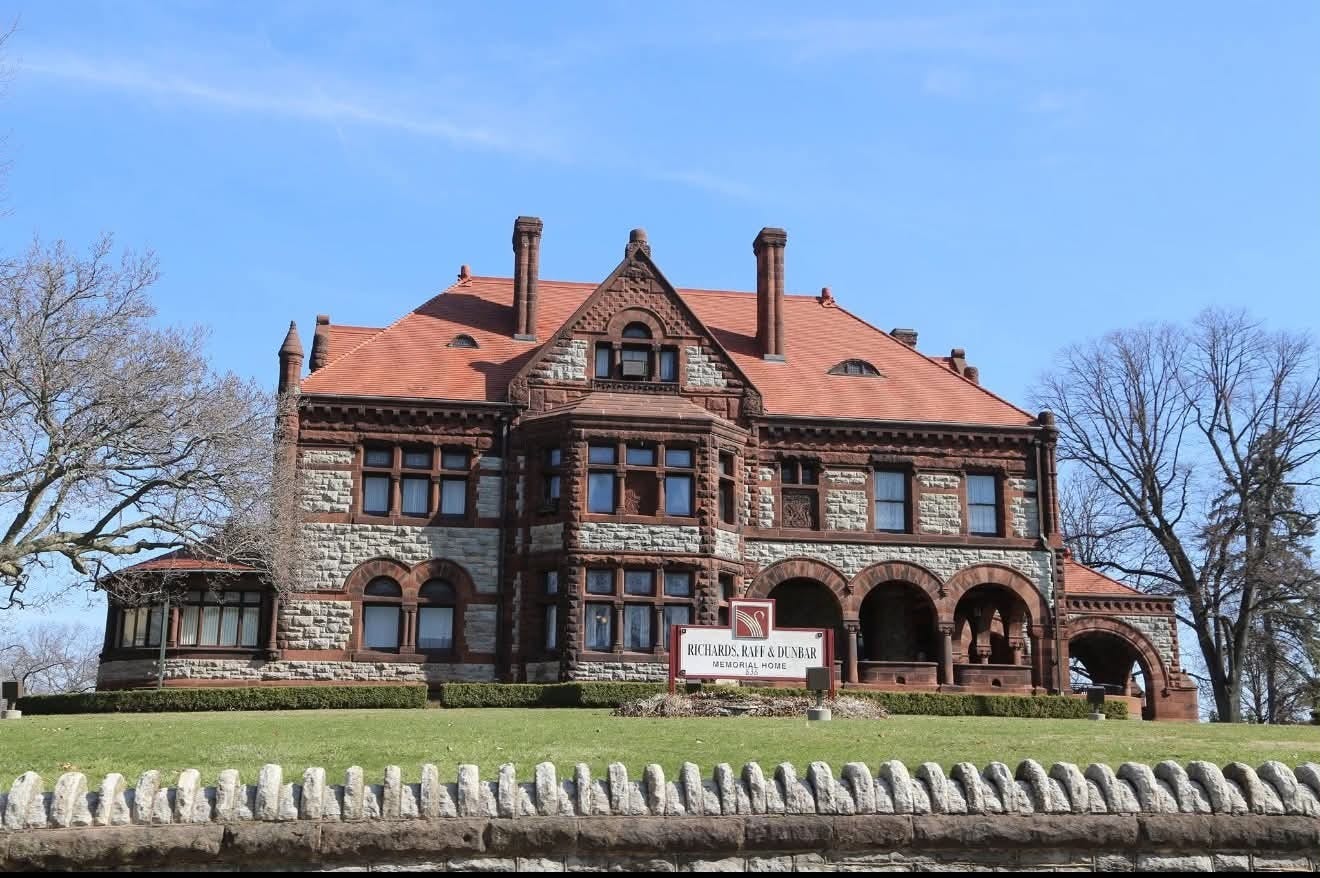
The Asa S. and Ellen L. Bushnell House, a historic mansion from the city’s prosperous past. Photo credit: Michael Morris, Springfield resident.
Shaelyn Holiday, a single mother from Ohio, was “stuck in a cycle of trying to get on my feet.” She and her children were living in a shelter when she met her now-husband, who had moved from Haiti to Springfield in 2023 and is now a green card holder. She credits him with helping to break that cycle, and after two years of each of them working two full-time jobs, they are now homeowners in Springfield. “It’s really hard to find somebody that thinks about long-term things,” Shaelyn says, describing how her husband’s strategic thinking contrasted with the short-term thinking she was prone to.
The long-term focus mattered because the short-term was not easy. According to Shaelyn the first house that she and her husband rented had boarded-up windows, no air conditioning, and was infested with roaches. There were ten adults and two children in the single-family home, and they even paid an extra fee to use the closet, which one of the adults slept in. Shaelyn says that the landlords knew that the living conditions were subpar but that “they took full advantage of anybody that would live in that house. Especially when it comes to people that are desperate.”
She says that most people are here to support loved ones back in Haiti, where gang violence has led to unspeakable trauma like that of the mother whose baby was ripped from her arms and thrown into a fire. Her husband doesn’t like to talk about it. His mother and 12-year-old son are both still there.
“They’re able to harbor their emotions very well,” Shaelyn says with a sense of reverence. “I would never guess these things my husband knows. And usually, it takes a lot for him to speak when he does.” Since ICE began detentions in August, Shaelyn has seen some of her former roommates leave for elsewhere or be detained, and others I spoke with said they saw fewer Haitians in the city, at work, or in the pews.
As the only nonimmigrant in the household, Shaelyn noticed cultural differences between the way she grew up and her new roommates: “A lot of people just knew each other. So anybody that came here, they would want to help each other.”
Shaelyn described how they’d pool money together for big purchases and then the recipient would send monthly payments back to the people who’d loaned the money. “That’s why you have them get restaurants and everything else, and that’s how they grow. They lean on each other, and a lot of us don’t do that… They help each other thrive. That way they’re able to survive.” Her husband’s first car was bought this way.
“But with us,” Shaelyn continued, referencing present-day Americans, “We’re always on defense of okay, can’t trust anybody. No one’s gonna help you. Everybody’s trying to be better than everybody else. Relying on each other is very difficult because everybody’s trying to think of themselves.”
Shaelyn thinks this is partly why she was stuck in a cycle for so long. She remembers her husband looking at her and saying, “Look at the people around you that are trying to help you.” He pointed out that she did have family willing to help, but that she was putting up a defense and wasn’t taking them up on it. She realized that he was right and that the only way to get ahead was to suffer through. She placed her children with family members so that she could work two full time jobs, like her husband was already doing. First, she would work as an inmate supervisor from 6 a.m. until 1:00 p.m. and then at a pharmaceutical factory from 3 p.m. to 11:00 p.m. “I would sleep for three hours a night. I would sit up sleeping just so I could get up for work.” At some point, she started sleeping in her car to save the drive time.
After two years of that schedule she and her husband were able to buy a home.
But despite these sacrifices, they are still struggling, and like so many other working- class Springfield residents, “are still scraping up change.” She reflects on the incentives in our system, and how it’s almost “easier to not work as hard.” When you make less, you are able to get help with things like food stamps and Medicaid, she says. “But as soon as you do hit a threshold, you struggle…the moment you get like $20 over what you’re supposed to, all your help can go away. And that $20 is not necessarily your $600 bill, right?”
My observation is that the conversation about public assistance programs, and in particular benefits cliffs, is often at the heart of angst about immigration. A gig economy worker told me she worries that if she makes a little too much money she might lose Medicaid for her and her son—and then added that she’d heard that Haitians in Springfield automatically qualify. Whatever the actual case, the demoralization associated with these incentives—and the frustration and resentment they inspire—are a real powder keg of the immigration debate. Not necessarily because people aren’t compassionate, but rather because they feel the fallout of what happens when the middle class disappears.
Michael Morris drives us down West Main Street, where he has memories of shopping with his mom when he was a kid. “There was the HVAC business. The tire guy over here—Stan’s Tire. You had the bakery,” he points and starts to list names, recreating a nostalgic frame of Main Street commerce. But now the street depresses him.
“Look at these boarded-up places. Houses that are gone, grass overgrown,” Michael says. “The bank down here even decided after they were robbed one too many times to close. That bank had been there literally all of my life, and now it’s a place where the poor can pay their electric bills.” The old bank sign now reads “HEAP Office,” Home Energy Assistance Program.
“Everything’s focused on the poor,” Michael vents. “Drives me crazy. It’s biblical. We need to take care of the poor, but we focus everything on the poor. We got to start focusing on bigger things. Anything but telling us how poor and impoverished and destitute and desperate we are.”
Michael’s theme on the tour has been this: “Why are we the way we are? A lot of it has to do with what we’ve lost and how we’ve taken it on the chin, and people forgetting how great we once were, and that greatness is still here.” He has a good deal of hope for Springfield, pointing out that pioneering aviation company Electra recently chose the city as the site of its first production facility. And he stresses that renewal will also require “an engaged citizenry” that will do the mundane things that create pride of place.
“Many working-class families helped build this valley in ways that should be honored, remembered, and respected,” Andrew, the lifelong Springfield resident, told me, before expressing his frustration with what he sees as the way that an immigration blame game has become a distraction from real response to present challenges. “What this nation has allowed is for us to be used as a talking point in politics—while watching us decline.”
Shaelyn says that her Haitian friends talk about America as the greatest country, which she understands in a way. But it also baffles her. “I bring this to my husband’s attention all the time: I don’t understand why you guys think this is the greatest country.” She thinks about how hard they’ve worked in order to arrive at what still feels like paycheck to paycheck precarity. Working enough hours to provide for their family comes with the tradeoff of not having time to spend with that family.
“This country is not built for people,” Shaelyn concludes.
As we say goodbye, Shaelyn proudly hefts up a car seat onto the table between us. Her four-month-old daughter smiles a dimpled smile. “My little Haitian-American,” she says.
Shaelyn has to leave because her husband made an appointment with an army recruiter, thinking that maybe that would be a viable route to stability. “He just does not want to struggle. I think the biggest fear is having to struggle.”
This strikes me as a sad sort of assimilation. Welcome to the American working class.

Got to reindustrialize and start again to build real things. Real jobs for real people that aspire to a stable middle class life. Hillary said that she had won 65% of the GDP in 2016. Technically true but what was it. Finance of questionable value, big law, entertainment, conspicuous consumption. No manufacturing since that had gone to China. Bringing it home will need to rely on places like Springfield.
Every day, politicians get to choose how they approach the myriad complex issues we ask them to handle on our behalf. They can choose to be constructive, and do their best to build consensus amongst our vast, hugely diverse population. Or, they can take the cheap and easy route of division and demagoguery in pursuit of personal advancement. The first route is far harder and requires statesmanship and political risk. But it is what is required for a civilized, pluralistic society to exist together and move forward. The second route is far easier, it merely requires shamelessness and narcissism. A willingness to place one's personal interests above the collective good.
Don and JD chose route two in Springfield. The performative cruelty they showed toward the situation tells us all we need to know about the character of these two men. JD actually had the temerity to admit he lied. "Those people", otherwise known as fellow human beings, were disposable to these two craven politicians. They were more than happy to exploit an already difficult and complex situation. Bomb threats in schools and hospitals, death threats, canceled schools and city services, added security costs. To say nothing of the fear inflicted on our fellow humans. None of the community impact mattered, they showed they cared not a whit about it's health. No, it was simply about using "those people's" skin color for personal political gain.
I would hope that readers of these pages would not allow their children to treat the brown girl sitting next to them in school in such a way. And yet, we allow our most powerful "leaders" to debase our society. We turn away, we stay silent. Commentators on the right in pages like these cower, afraid to call out such despicable behavior in hopes of cleansing the "new" right movement of rank racism. Such cleansing can only happen from within. But doing so apparently carries too high a cost. Depressed fundraising and fewer party invites apparently mean more than character, integrity, and the truth. Sadly, in the end, their silence is acceptance and support. And so, the actions of the leaders of the "new" right are given short shrift, just a passing mention, almost as if they were inevitable given the technological revolution that has swept the world.
Shame on Don and JD. And shame on those who fail to use their platforms to call them out.