


It has become fashionable in the wake of an electoral defeat for the losing team to claim that the election was stolen. The term “election denier” often conjures to mind President Donald Trump and his 2020 “Stop the Steal” campaign that culminated in the Jan. 6 Capitol attack.
But viewing Trump as the primary mover of American election denial misunderstands both the stolen election claims that helped pave the way for Trump’s, and those that have continued since—often given voice by his chief antagonists.
With the 2026 midterms only days away, recent evidence suggests the losing side is likely to pull the same tricks when votes are counted. And as with past efforts, such claims aren’t likely to succeed—or age well.
A Brief History of Disputed Elections
After its triumphant formation, it took the United States of America a few decades to get into a groove on the peaceful transfer of power. President George Washington announced in 1796 that he would not seek a third term, establishing the precedent of power transferring from one presidency to the next after no more than two terms, with a winner decided by vote.
But it didn’t take long for things to get messy. The election of 1800 saw Thomas Jefferson and Aaron Burr tie in the Electoral College, requiring 36 rounds of runoff votes for Congress to declare Jefferson the winner. The process inspired heated calls for secession, plus a duel that ended Alexander Hamilton’s life and, worse yet, birthed the eponymous musical dedicated to him.
A quarter-century later, Congress again had to decide between candidates when none reached a majority in the Electoral College, handing the office to John Quincy Adams over future President Andrew Jackson in 1824. The “corrupt bargain” between Quincy Adams and the powerful House Speaker-turned-Secretary of State Henry Clay spurred more outrage and birthed our oppositional two-party system.
Then came the election of 1860, where anti-slavery Republican Abraham Lincoln’s victory split apart the Democratic Party and led its Southern branch of it to secede from the Union rather than honor the results.
After, and perhaps because of, the bloody Civil War that followed, the peaceful transfer of power largely became a sleepy affair, punctuated by moments of confusion rather than violence.
In 1876, widespread voter fraud and challenges to state-level election results led both Republican Rutherford B. Hayes and Democrat Samuel Tilden to declare victory. Rather than settle the debate by a bullet, a bipartisan commission was established consisting of congressmen and Supreme Court justices, who eventually delivered the victory to Hayes in exchange for Reconstruction ending in the South.
There were presidential races that were too close to call—and even called incorrectly—on Election Day. In 1916, the race between incumbent President Woodrow Wilson and Charles Evans Hughes was so tight that numerous newspapers called it wrongly for Hughes, who would eventually concede defeat gracefully. The 1960 election between Richard Nixon and John F. Kennedy presented a similar fight to the finish, with allegations of voter fraud and other unsavory behavior in key states. But eventual-President Nixon chose not to contest these outcomes, conceding defeat to Kennedy.
The most contested election of the modern era came in 2000. The race between Democrat Al Gore and Republican George W. Bush came down to a razor-thin margin of 537 votes in the then-swing state of Florida. Gore took the matter to court in Florida under a law that allowed him to contest the results, arguing for a review of uncounted ballots in the state. But the U.S. Supreme Court, in Bush v. Gore, ruled that the race was over: Bush was the winner of Florida’s 25 electoral votes, and with it the presidency.
That such a ruling would become the law of the land, without violence or insurrection, is a remarkable testament to the American system. But it also kicked up a new American tradition: questioning whether the President of the United States was truly legitimate.
In January 2001, when Congress convened to certify the Electoral College results, a dozen Democrats objected, denying that Bush was the rightful winner. One objector, Rep. Maxine Waters (D-CA), is still in office. A year later, former First Lady Hilary Clinton famously declared that Bush was “selected, not elected.” Gore himself later declared he thought “if everyone in Florida who tried to vote had had his or her vote counted properly, that I would have won.” In 2013, then-Senator Joe Biden alleged that Gore “really did win” the 2000 election, but accepted defeat “for the good of the nation.” Countless other Democrats have claimed the 2000 election was “stolen,” that Bush’s victory was “fraudulent,” and more.
While there were doubts and objections, the defeated candidates conceded quickly in the presidential elections of 2004, 2008, and 2012.
‘Not My President’
But then something truly inconceivable happened. Despite polls suggesting his campaign was dead on arrival, Donald Trump won the 2016 election, shocking the political system and the American (and global) public. With it came sputtering disbelief and rage from the American Left, and shortly thereafter, suggestions that perhaps something wasn’t quite right—or perhaps, quite legitimate—about Trump’s victory.
It started with reports from the intelligence community that Russia had interfered, sowing division and chaos via bot farms and other abuses of America’s election laws that favored Trump over Clinton.
Amid Trump’s warming posture toward Moscow, that claim shifted to the suggestion, from elected Democrats, legacy media, and beyond, that the Trump campaign had in fact been working with the Russian government, birthing a conspiracy dubbed “Russian collusion.”
With it came a return to the same accusations of illegitimacy that Democrats hurled at George W. Bush.
The same Rep. Maxine Waters who objected to Bush’s certification has called Trump “Putin’s apprentice.” Civil rights icon and former Georgia Democratic Rep. John Lewis told NBC News he didn’t “see this president-elect as a legitimate president.”
At its peak, proponents of the theory even suggested that Trump was in fact a Manchurian candidate, placed in the Oval Office by Russian President Vladimir Putin to act on Moscow’s behalf. This view was shared by tens of thousands of “Not My President” protesters in D.C. and across the country.
The notion that Trump was somehow illegitimately elected has been parroted by his 2016 opponent, Hilary Clinton, by his eventual 2020 and 2024 opponents, and by countless Democratic elected officials and other voices.


That cloud of impropriety hung over Trump’s first term, spawning an (unsuccessful) impeachment process; an (unsuccessful for Democrats) external review of the facts by former FBI Director Robert S. Mueller III, and a stasis in Washington that ground real action to a halt during the first Trump administration.
The allegations, while never substantiated, also stuck in the minds of millions of ordinary Americans. One poll conducted in 2019 found that nearly half of Americans regardless of party believed Trump worked with Russia to steal the 2016 election. But the illegitimate claims were memoryholed or at least pushed out of the spotlight in 2020, when Trump began his own assault on the peaceful transfer of power.
January 6 and Beyond
It started in the immediate wake of Election Day 2020, when Trump advanced unsupported allegations of massive voter fraud and other malfeasance, claims that kicked off the “Stop the Steal” campaign to nullify former President Joe Biden’s electoral victory.
Of primary concern was the outcome in Georgia. Trump alleged tens of thousands of illegitimate votes and pressured Georgia Secretary of State Brad Raffensberger to find the votes necessary to allow Trump to win the state. Raffensberger declined, acting as something like the electoral body’s white blood cells fighting off an infection, holding the line on election law and preventing the Electoral College count from falling into dispute. At least for a time.
Then came Jan. 6, 2021. Trump delivered an address to protesters outside the White House on the day of the election’s certification, telling attendees that “we will never give up, we will never concede. It doesn’t happen. You don’t concede when there’s theft involved.”
Thereafter, some Republican members of the House of Representatives objected to verifying the outcome, sending the Capitol into chaos. Protesters swarmed the building, ransacked multiple rooms, threatened members of Congress in the halls, and stalled the certification process as members rushed for safety. One protester, Ashley Babbitt, was shot and killed in the melee.
Amid that chaos, power did eventually change hands. Lawmakers returned to the Capitol to certify President Biden’s victory. Trump’s former Vice President, Mike Pence, declared: “To those who wreaked havoc in our Capitol today, you did not win. Violence never wins. Freedom wins, and this is still the people’s house.”
Yet despite the bedlam, Trump left the White House and pledged an orderly transition. President Biden took office as scheduled at noon on Jan. 20 and American life clicked back into place. It was galling behavior, yes, but a far cry from the Civil War.
Afterward, election denial became the cardinal sin in politics for the Left and the legacy media; “the Big Lie,” “fascism,” “a threat to democracy.” Denying election outcomes was the stuff of tyrants, dictators, Hitler, and Donald Trump.
This turn was especially bad for one Democratic icon who continued insisting that she had been cheated out of an election: Stacey Abrams, shadow governor of Georgia. Despite having lost the 2018 election to Brian Kemp, Abrams—a darling of the progressive Left, keynote speaker at the 2020 Democratic National Convention, and erstwhile head of a reportedly fraudulent get-out-the-vote nonprofit—spent years refusing to concede defeat, before and after Trump had done so.
Democrats didn’t cry foul in the face of her election denial; they embraced Abrams’ and her fact-defying beliefs. Rather than push her out of the spotlight, the Democratic Party selected Abrams to deliver the official rebuttal to Trump’s 2019 State of the Union address; after her election defeat but well before she stopped denying her loss.
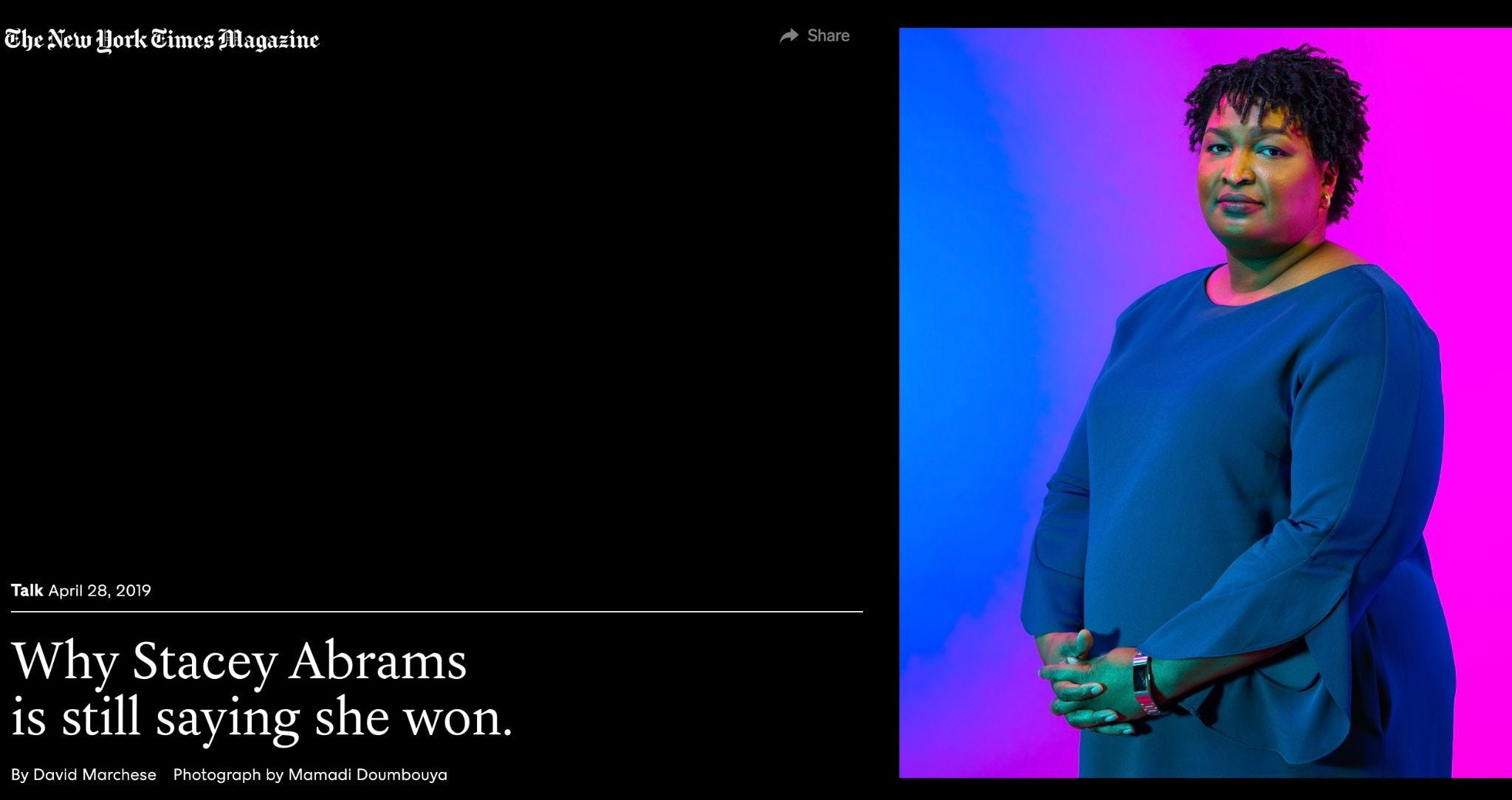
When Democratic presidential candidates began traveling to Abrams’ home state of Georgia ahead of the 2020 primary, would-be standard bearers were practically climbing over one another to spout election denial.
Former South Bend, Indiana Mayor Pete Buttigieg declared that “we cannot truly say we live in a democracy” after Abrams lost. Joe Biden asserted that “voter suppression is the reason why Stacey Abrams isn’t governor right now.” Former Vice President Kamala Harris would later say the same. New Jersey Senator Cory Booker claimed the election was “stolen,” as did former Ohio Senator Sherrod Brown. Hilary Clinton joined in here, too.
A few years later, the election-fallacy narrative got fresh legs when Democratic former Virginia Governor Terry McAuliffe told an audience that Abrams would be the governor of Georgia except that the state “took the votes away” from her would-be voters. A few years later, Biden would dust off his own tendency to deny inconvenient elections, calling McAuliffe “the real governor” of Virginia.
Other Left-wing voices would do the same, led by would-be Florida governor Andrew Gillum’s quixotic vote dispute and former Rep. Anthony Brindisi’s failed effort to count disqualified ballots.
And then there are the Left-wing assertions of attempted election theft. Do you remember when Trump was using the United States Postal Service to steal the election? No, not the current claims, but the ones from 2020, when former Speaker Nancy Pelosi called the House back into session to stop Trump from stealing the election by mail?
The Union Holds
This history should make all of us appreciate the fact that, since the Civil War, America has witnessed a peaceful—if sometimes contentious—transfer of power.
It can be easy to lose sight of how unprecedented that is in human history. A majority of the world’s countries have been established since 1850. France has had four different governing regimes since that date. Countless countries have seen coups, violent overthrows, breakups, and conquests. Yet America—despite its perpetually inflamed political tensions and the presence of more guns than anywhere else in the world—has held stable.
With midterm elections on the horizon, recent history suggests that election denial will once again dominate headlines.
Every election brings with it details that sound odd to one side or the other: Did a water pipe in an election-counting location in the tossup state of Georgia really break during vote counting in 2020? Were election monitors really blocked that same year in Pennsylvania? A weak election system gives rise to suspicions, inflamed by social media and bad actors foreign and domestic, that these are sure signs of a stolen election.
Rather than treat these hiccups as signals of the end of our democratic republic, such concerns should push states to consider ways to strengthen their elections and provide confidence in the results. Doing so might just allow us to escape a furious round of stolen election claims.
At least the Rs are trying to check IDs and reduce the avenues for fraud in mail voting. The Ds seem hellbent on running elections as janky as possible, and pissing in the face of anyone who objects. Are they trying to provoke an angry response that they can use as a pretext for a crackdown?
Just gonna put this here. Do what you want with this. https://youtu.be/uR_X2L9SJR8